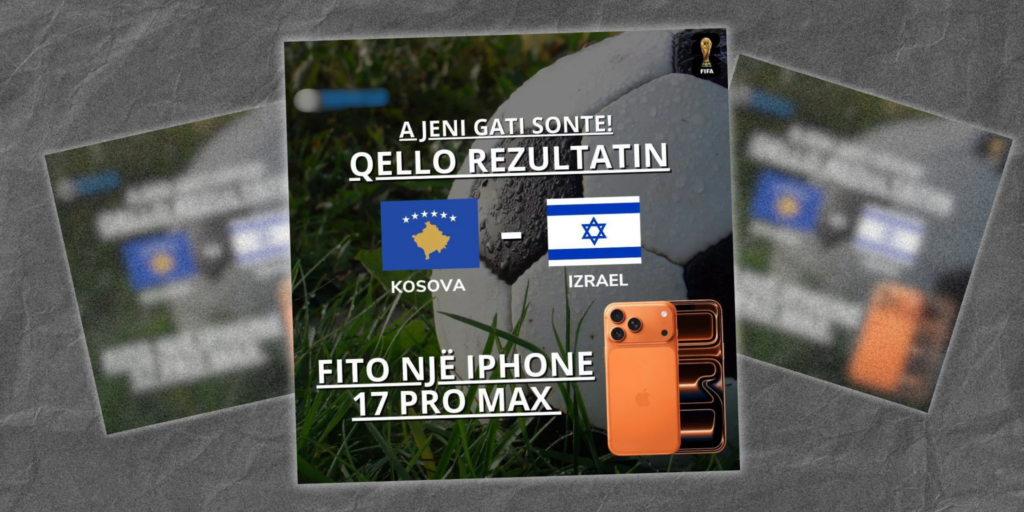

Through a publication on the Facebook page "Universal", claims to be offering an iPhone 17 Pro Max to the person who guesses the score of the Kosovo-Israel football match.
The publication was made on November 14, 2026, the day the match between Kosovo and Israel took place. Through this post, it is claimed that users are offered the opportunity to win an electronic device if they guess the result of the match.
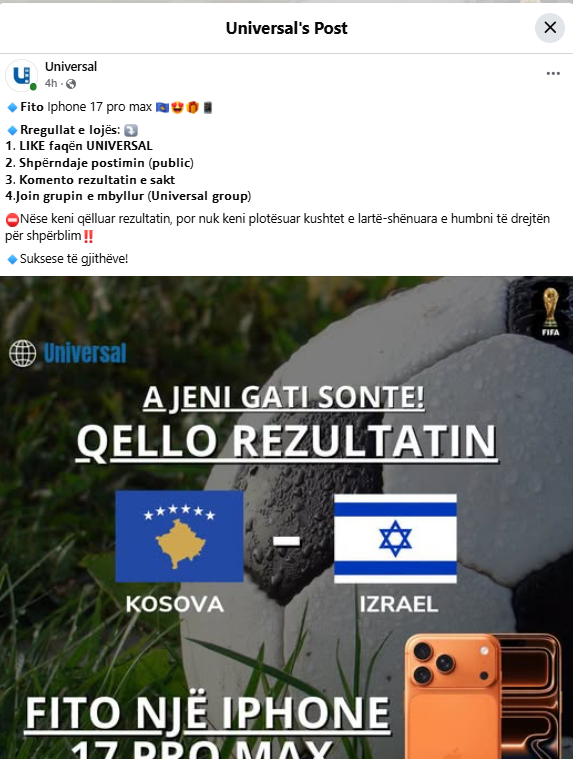
However, this publication represents a continuation of a practice that hibrid.info had previously addressed.
The phenomenon was previously identified by hibrid.info
On March 13, 2026, hibrid.info published the article titled "The phenomenon of dubious reward games to boost Facebook pages".
Three Facebook pages were identified in that article: “Universal","Liria”And“Star.net", which published content claiming to organize prize games, mainly asking users to guess the results of football matches.
In exchange for participation, users were asked to like the pages, comment on the results, and share the publications.
Hibrid.info found that, despite the high number of interactions, these sites did not provide clear evidence of the announcement of winners and the delivery of promised prizes (see here).
In the case of the "Universal" page, by the time of the publication of the March article, nine such publications had been identified since 2024. Also, in the comments of the posts there were users who claimed that they had not received the rewards, even though they had met the required conditions.
The practice continues, while the other two sites no longer exist.
Even the latest publication of the page "Universal" follows the same modus operandi: it offers a claimed reward and conditions participation with commenting on the result of a football match.
Of the three pages identified in the previous Hibrid.info article, “Liria” and “Ylli.net” are no longer accessible on Facebook (see here and here), while the "Universal" page continues to publish content.
However, the latest publication does not provide evidence that the promised reward will be given to any of the participants. Also, the lack of evidence of previous rewards remains one of the main problems with this practice.
The “Like-farming” phenomenon
Such publications are related to the practice known as "like-farming", which aims to increase interactions on social networks.
Users are encouraged to react, comment, and share publications, contributing to increasing the visibility and interactions of the site.
In the previous article, hibrid.info had explained that these practices can create the impression of greater popularity of the sites, without providing transparency about the claimed rewards.
cONcluSiON
The latest case shows that the practice of publishing dubious reward games on Facebook continues, even after hibrid.info had previously addressed this phenomenon.
Users are advised to be wary of publications that promise rewards in exchange for likes, comments, and shares, especially when clear rules of the game and evidence of prize delivery are lacking.