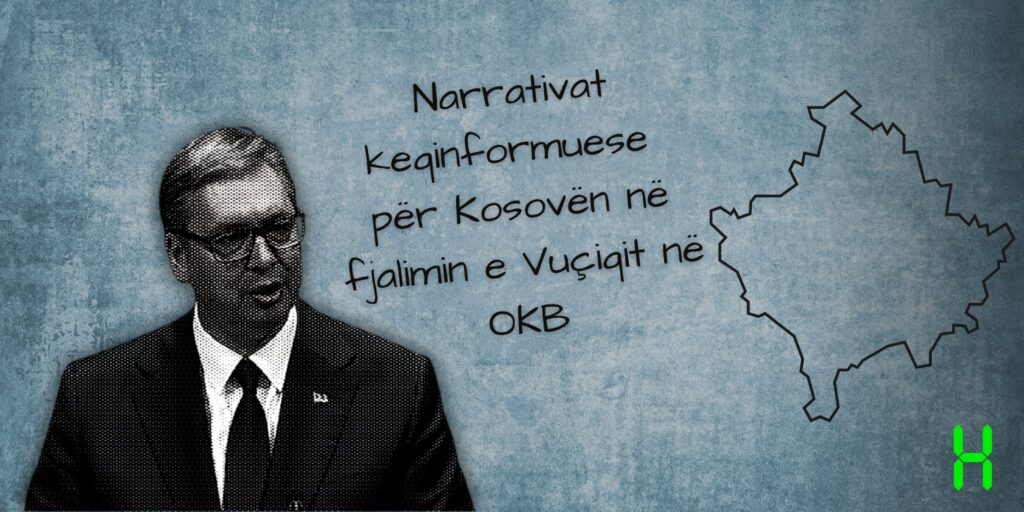

in ADDRESS In his address to the United Nations General Assembly, Serbian President Aleksandar Vučić placed the Kosovo issue within a broader narrative about international order, respect for the UN Charter, and the claim of double standards in the implementation of the principles of territorial integrity. In this context, he presented several interconnected narratives about Kosovo, the 1999 war, Kosovo’s independence, and the Kosovo–Serbia dialogue.
The narrative of double standards for territorial integrity
One of the main thrusts of the speech was the claim that the principle of territorial integrity does not apply equally to all states. Vučić argued that the international order based on the UN Charter has been damaged by the interventions of great powers, and he directly linked this claim to the case of Kosovo.
He compared Kosovo to Ukraine. According to his argument, in the case of Ukraine the international community protects the territorial integrity of a state from the use of force, while in the case of Serbia, according to him, the great powers themselves used force against it and then supported Kosovo's independence.
This is a political analogy built on the principle of territorial integrity, but it leaves out important differences between the two cases. In Ukraine, resolutions UN General Assembly resolution ES-11/1 describes the Russian action of 24 February 2022 as aggression and condemns the use of force by Russia within the sovereign territory of Ukraine. In the case of Kosovo, prior to NATO intervention, there was an internal armed conflict on the territory of the Federal Republic of Yugoslavia, involving Serbian/Yugoslav forces and Kosovo Albanian armed forces, as well as a severe humanitarian crisis.
Resolution 1199 The Security Council resolution, adopted in September 1998, called for a cessation of hostilities by all parties, while expressing particular concern about the excessive and indiscriminate use of force by Serbian forces and the Yugoslav Army. At the same time, it also called on the Kosovo Albanian leadership to condemn terrorist acts and to engage in dialogue.
Therefore, Vučić's comparison creates a political parallel between the two cases through the principle of territorial integrity, but does not take into account the difference between an interstate aggression like Russia's against Ukraine and an internal armed conflict in Kosovo, which preceded NATO's intervention.
NATO of 1999 as evidence of "double standards"
Another important part of Vučić's narrative relates to NATO's intervention in 1999. He stressed that the bombings of the Federal Republic of Yugoslavia (FRY) were not authorized by a UN Security Council decision and presented them as an example of the use of force by Western powers outside the purported international order.
The fact that NATO launched the air campaign on 24 March 1999 without a Security Council resolution expressly authorising the use of force is part of the legal and political debate surrounding the intervention. However, prior to the intervention, there were Security Council resolutions on the situation in Kosovo, including Resolution 1199, which operated under Chapter VII and documented the fighting, population displacement and humanitarian crisis.
After the end of the NATO campaign, the Security Council approved Resolution 1244, which provided for the establishment of an international civilian and security presence in Kosovo, and reaffirmed the commitment of member states to the sovereignty and territorial integrity of the Federal Republic of Yugoslavia, while simultaneously providing for substantial autonomy and self-administration for Kosovo.
So, in Vučić's narrative, the 1999 intervention serves as the starting point for the argument that Western powers applied one standard to themselves and another to Serbia.
Kosovo as a “violation” of the UN Charter and Resolution 1244
Vučić presented Kosovo's independence as a result of a violation of the principles of the UN Charter and Resolution 1244, linking it to the claim that part of Serbia's territory was illegally seceded.
Resolution 1244 did reaffirm the commitment of member states to the sovereignty and territorial integrity of the Federal Republic of Yugoslavia, but it also established an interim international regime in Kosovo and provided for a political process for determining its future status.
But a key element in this debate is Advisory Opinion of the International Court of Justice (ICJ) of 2010. The Court found that Kosovo’s declaration of independence of 17 February 2008 did not violate international law. It also concluded that the declaration did not violate Resolution 1244.
Brussels Agreement: Serbia as a party that has fulfilled its obligations and the internationals as failed guarantors
In the section on the Kosovo-Serbia dialogue, Vučić focused particularly on The Brussels Agreement of 2013He argued that Serbia has fulfilled its obligations, while the obligation to establish the Association of Serb-majority Municipalities remains unfulfilled by the Kosovo side.
However, his narrative is not simply that the Kosovar side has not implemented the agreement. Vučić also places responsibility on international factors, claiming that internationals have not ensured equal implementation of obligations.
This builds a broader narrative that presents Serbia as a party that has made concessions under international pressure, while the international factor is presented as a guarantor that has not ensured the mutual implementation of agreements.
EU documents show a more complex picture (see here, here and here). Following the agreement of 19 April 2013, concrete steps were taken to implement it, including the integration of municipal, police and justice structures into the legal framework of Kosovo and the organisation of local elections in the northern municipalities. EU documents from that period described the implementation of the main elements of the agreement as a process that was taking place in practice.
On the other hand, the latest reports of the European Commission present the dialogue as a process where both parties have obligations and cases of non-implementation. Report for Serbia for 2025 notes significant problems in fulfilling dialogue obligations, while the report on Kosovo also highlights actions of Kosovo institutions that are not considered in line with dialogue obligations. For the Association of Serb-majority Municipalities, the EU continues to consider Kosovo responsible for initiating the process towards its establishment, while Serbia has parallel obligations under the dialogue agreements.
Thus, Vučić's presentation reduces a multilateral and multi-year process to a framework where Serbia is presented as a party that has fulfilled its obligations, the Kosovo side as a party that has not fulfilled a key obligation, and the internationals as a factor that has exerted pressure on Serbia without guaranteeing reciprocal implementation.
Kosovo as a product of a one-sided international order
These narratives merge into a single political message, where Kosovo is presented by Vučić as the main example of an international order that, according to him, does not equally apply the principles of sovereignty and territorial integrity.
Thus, Vučić presents the NATO intervention in 1999 and the independence of Kosovo as examples of the, in his opinion, selective application of the principles of territorial integrity. He also refers to the Brussels Agreement to present Serbia as a party that has made concessions, while Kosovo as responsible for the failure to implement some of its obligations. In addition, he links international support for Ukraine to attitudes towards Kosovo, using this comparison to argue that the same principles are not applied in the same way in international cases.
In this way, the speech does not treat Kosovo solely as a bilateral issue between Belgrade and Pristina. Vučić places it at the center of a broader narrative about the international order, the power of great states, and the claim that the principles of international law are selectively applied.