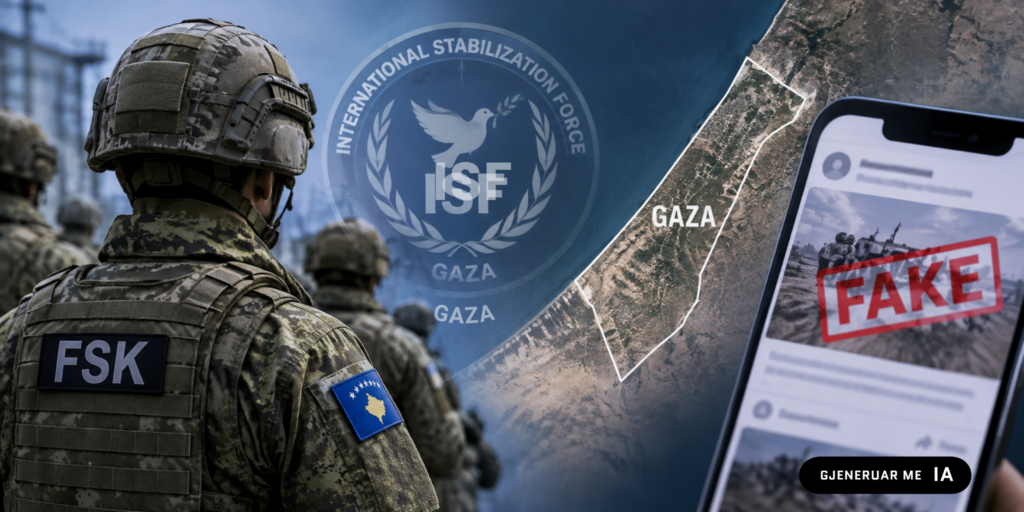

The participation of the Kosovo Security Force (KSF) in the International Stabilization Force in Gaza (ISF) is a development of institutional and public importance for Kosovo. Due to the sensitivity of the conflict in Gaza and the interest that this mission may arouse in the public, the topic can also be used to spread incorrect information, misinterpret developments and manipulate content on social networks.
Such cases have already been identified by Hibrid.info. In two different publications on TikTok, false claims were spread about the killing of KSF members and their involvement in armed clashes with Hamas in Gaza.
However, misinformation on this topic is not necessarily limited to the repetition of these claims. It can also manifest itself through other ways of presenting and interpreting information. For this reason, rather than anticipating specific claims that might be published, it is more useful to identify manipulation techniques that might be used in reporting on this mission.
What is known so far about the KSF mission?
On April 17, 2026, the Assembly of Kosovo approved with 89 votes the participation of the KSF in the International Stabilization Force in Gaza (see hereOn April 20, 2026, the acting president authorized the sending of KSF members to this mission (see here).
Kosovo's contribution is expected to include an explosive ordnance disposal (EOD) team, a contingent commander who will serve as a liaison officer, and other support personnel.
However, institutional approval and contingent preparation do not mean that KSF members have begun operations in Gaza.
According to a response from the Ministry of Defense to the media "The Times of Israel", published on October 26, 2026, the Kosovo explosive ordnance disposal team was ready for deployment, but its deployment depended on the International Stabilization Force's willingness to accept the contingent.
Likewise, the visit of a KSF team to Gaza, on 26 April 2026, was preliminary in nature and served to assess the area where the contingent was expected to operate. It did not constitute the start of the operational deployment (see here).
This information is important for understanding the difference between the decision to participate, preparations for the mission, and the start of field operations. This distinction also helps in assessing claims that may be presented as new developments about the mission.
What false claims have been published so far?
On November 4, 2026, an image was posted on TikTok claiming that Kosovo soldiers had clashed with Hamas members in the Gaza Strip, killing 20 Palestinians who were posing as members of the organization's armed wing. The same post claimed that Israel had thanked the Kosovo soldiers for this action.
The content was presented in the form of a news broadcast by Klan Kosova. However, Hibrid.info verification found no reports confirming the event, while analysis of the image showed a high possibility that it was generated by artificial intelligence (AI). Furthermore, the KSF contingent had not yet been deployed to Gaza.
On November 6, 2026, another image was posted on TikTok, also presented as news from Klan Kosova. This time, it was claimed that two members of the Kosovo Security Force had lost their lives after a drone attack in northern Gaza.
This claim was also deemed false. Hibrid.info Verification showed that the image was created with artificial intelligence, while no report on the alleged event was found in the Klan Kosova archive and other media.
These two cases show that the mission topic has already been used to create fabricated content, exploiting public interest. However, they are only examples of possible ways of manipulation and do not mean that future content will necessarily take the same form.
How can the public be misinformed about the KSF's mission?
The two latest cases verified by Hibrid.info show several ways in which this issue can be exploited to spread incorrect information. Some of them have already been observed in the publications discussed, while others constitute possible scenarios, based on the context of the mission and the developments related to it.
Since it is impossible to predict with certainty the specific claims that may be published, the following presents possible ways of manipulation and what citizens should keep in mind to distinguish them.
Detaching developments from their context
One possible way of misinformation is to present a true development, but without the necessary context, so that the public draws the wrong conclusions.
For example, the preliminary visit of KSF members to Gaza could be presented as evidence that the Kosovo contingent has already been deployed there and has begun operations. However, the visit of 26 April 2026 was of an evaluative nature and did not signify the start of the operational mission.
To evaluate such a claim, it is important to check which phase of the mission it is about and whether the information has been updated with the latest developments.
Misinterpretation of the mandate and role of the KSF
Another way is to present the role of the KSF in the international mission in Gaza inaccurately, attributing to it tasks or powers that have not been confirmed.
Published information about the Kosovo contingent has mainly mentioned an explosive ordnance disposal (EOD) team, liaison officers and support personnel. This should not automatically be interpreted as participation in combat operations or clashes with armed groups.
Before believing a claim about the duties of KSF members, it must be verified whether it complies with the mandate and composition of the contingent confirmed by the institutions.
Attribution of events in Gaza to KSF members without evidence
Various developments in Gaza can be used to create claims that members of the KSF are involved, without any evidence to support this connection.
In the last two cases covered by Hibrid.info, it was claimed that two KSF soldiers had been killed by a drone attack and that its members had clashed with Hamas. Both claims were deemed untrue, while at that time the KSF contingent had not yet been deployed to the field to begin the operational mission.
Therefore, reports of attacks, casualties or clashes in Gaza should not be automatically attributed to the KSF. Such a claim should be based on credible confirmation and not just on the description accompanying a photo or video.
Using visual materials to create false evidence
Photos and videos can be used to lend credibility to a false claim. This can be done through artificial intelligence-generated images, old photos, or materials from other events.
In the last two cases verified by Hibrid.info, the publications were accompanied by images that were presented as evidence of the alleged events. Analysis with artificial intelligence-based content detection tools suggested that they could have been artificially generated.
However, an image should not be considered authentic just because it looks convincing. It should be checked whether it has also been published by other reliable sources, whether its origin can be traced, and whether it matches confirmed information about the event.
Presenting fabricated content as media reports
An unfounded claim can take on the appearance of a news story published by a well-known media outlet. This can be done by imitating the media outlet's logo, graphic design, headlines, or visual formats.
This method of manipulation has been observed in the two recent cases handled by Hibrid.info, where TikTok publications were presented as representing reports from Klan Kosova.
For this reason, when a photo or video appears with a media outlet's logo, one should check whether the same reporting is found on its website or official accounts. The mere presence of the logo does not prove that the content was published by that media outlet.
How to verify mission information?
To distinguish these forms of manipulation, it is not enough to simply know the facts about the mission. It is also necessary to evaluate the way the information is presented and the source from which it comes.
First, readers should consider some basic facts about the mission: the Assembly's decision, the tasks envisaged for the contingent, and the status of the deployment. This information serves as a reference point for assessing whether a claim is consistent with what is known.
Second, the logic of the claim must be examined. Does the information presented really prove the conclusion drawn from it? Is a preliminary visit evidence of the start of operations? Does an event in Gaza prove that the KSF was involved? Is a photograph evidence of the event described in the publication? These questions help identify conclusions drawn without sufficient evidence.
Third, the credibility of the source should be assessed. Publications that do not indicate where they got their information from, accounts that imitate media outlets, and visual materials without an original source require special care. For claims related to military developments, casualties, or operations, it is important to also seek confirmation from responsible institutions and reports from credible media.
In practice, readers can follow these steps:
- Check the source: If a publication appears as news from a television station or portal, look for it on that medium's official website and accounts.
- Look for the full context: Don't just rely on a headline or excerpt of a statement. Check what was said, under what circumstances, and on what date.
- Compare the claim with known facts: Distinguish institutional decisions and preparations from developments that have actually occurred on the ground.
- Verify the photos and videos: Use tools like Google Lens to search for the source of photos and see if they have been published previously in other contexts, and “HiveModeration” to verify whether content was generated by artificial intelligence (AI).
- Seek independent confirmation: For important claims, check for reporting from other credible media or official information.
- Do not immediately share unconfirmed content: Especially when it comes to casualties, clashes, or military developments, information must be verified before being treated as fact.