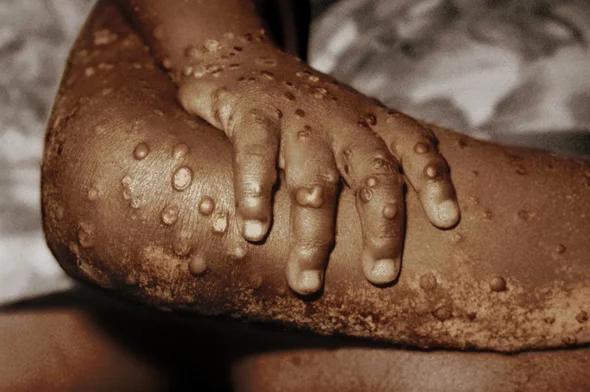

Essay by a microbiologist reprinted in scientificamerican.com, with permission from the author
On May 18, 2022, Massachusetts health officials and the Centers for Disease Control and Prevention confirmed a single case of monkeypox in a patient who had recently traveled to Canada. Cases have also been reported in the United Kingdom and Europe.
Monkeypox is not a new disease. The first confirmed case of this disease in humans was in 1970, when the virus was isolated from a suspected child in the Democratic Republic of Congo (DRC). Monkeypox is unlikely to cause another pandemic, but with the fear of COVID-19, there is understandable concern about another major outbreak. Although rare and usually mild, monkeypox can still cause serious illness. Health officials are concerned that more cases will emerge as travel increases.
I am a researcher who has worked in public health and medical laboratories for over three decades, particularly in the field of diseases of animal origin. What exactly is happening in the current outbreak, and what does the story tell us about monkeypox?
Monkeypox is caused by monkeypox virus, which belongs to a subgroup of viruses in the family Poxviridae called Orthopoxvirus. This subgroup includes smallpox, vaccinia, and cowpox viruses. While the origin of monkeypox virus is unknown, African rodents are suspected to play a role in transmission. Monkeypox virus has only been isolated twice from an animal in the wild. Diagnostic testing for monkeypox is currently available only at Laboratory Response Network laboratories in the United States and around the world.
The name “monkey pox” comes from the first documented cases of the disease in animals in 1958, when two outbreaks occurred in monkeys kept for research. However, the virus did not jump from monkeys to humans, nor are monkeys the primary carriers of the disease.
Since the first reported human case, monkeypox has been found in several other countries in Central and West Africa, with most infections in Congo. Cases outside Africa have been linked to international travel or imported animals, including in the United States and elsewhere.
The first reported cases of monkeypox in the U.S. were in 2003, from an outbreak in Texas linked to a shipment of animals from Ghana. There were also cases linked to travel in November and July 2021 in Maryland.
Because monkeypox is closely related to smallpox, the smallpox vaccine can provide protection against infection by both viruses. However, since smallpox was officially eradicated, routine smallpox vaccinations for the general U.S. population were discontinued in 1972. As a result, monkeypox has increasingly appeared in unvaccinated people.
Because monkeypox is closely related to smallpox, the smallpox vaccine can provide protection against infection by both viruses. However, since smallpox was officially eradicated, routine smallpox vaccinations for the general U.S. population were discontinued in 1972. As a result, monkeypox has increasingly appeared in unvaccinated people.
The virus can be transmitted through contact with an infected person or animal or contaminated surfaces. Typically, the virus enters the body through broken skin, inhalation, or mucous membranes of the eyes, nose, or mouth. Researchers believe that human-to-human transmission is primarily through inhalation of large respiratory droplets rather than direct contact with bodily fluids or indirect contact through clothing. The rate of human-to-human transmission of monkeypox has been limited.
Health officials are concerned that the virus could be spreading undetected through community transmission, perhaps through a new mechanism or route. Where and how infections are occurring are still under investigation.
(Full article in English published in scientificamerican.com)