

Images have been published showing the results of support for political parties in Kosovo, from public opinion surveys, ahead of the June 7 parliamentary elections.
The content, which claims to be a survey published by a research center, was published on Friday (June 5) on the website and Facebook page of the media outlet “Kosovapost.com” (see here and here), while on Saturday (June 6) on the website and Facebook page of a portal called "Realiteti" (see here and here) and on the Facebook page called “Lajmet Aktuale” (see here).
What's wrong with this content?
This content presented an unreliable survey.
To assess the credibility of this alleged survey, hibrid.info has verified whether it meets the standards and criteria required for such a measurement of public opinion.
What are surveys?
A survey is a preliminary research to identify a situation, opinions or attitudes about something specific. In this statistical method, results are drawn based on the study of a part of the population, called a sample.
Based on an article by the Pew Research Institute (a research institute for fact-based surveys and studies), it clarifies what information should be sought about how a survey was conducted.
Who conducted the survey and who sponsored it?
Who was interviewed?
How was the survey conducted?
How were people selected for the survey?
When was the survey conducted?
How many people were interviewed?
Was the survey weighted? If so, how?
Do the survey questions seem neutral and fair?
In this image, released on behalf of the “ALTERNATIVE Research Center”, the content lacks all essential technical data such as the sample (how many people were interviewed), the method of selecting people, the time period when the survey was conducted, as well as the interviewing method. In addition to this verification, it was deemed necessary to verify whether the company is officially registered and whether the infographic has been published on their official channels.
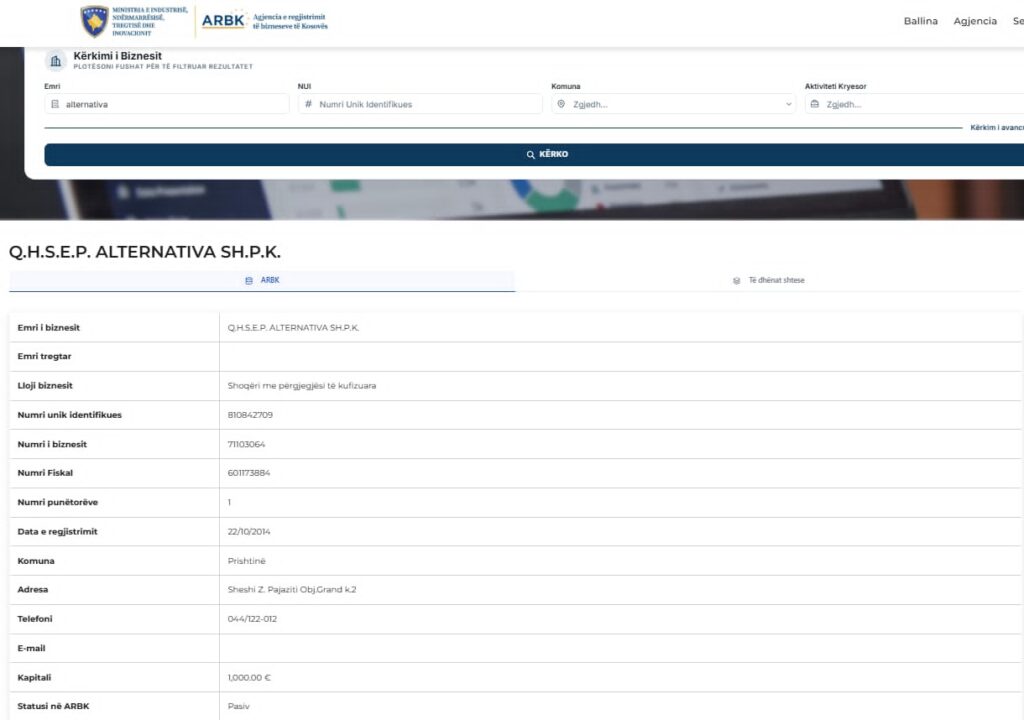
Hibrid.info researched this organization to verify its institutional credibility. “ALTERNATIVE Research Center” does not appear in any official register of Non-Governmental Organizations (NGOs) or taxpayers in the country (see here and here).
The organization in question was found registered only with the Kosovo Business Registration Agency (KBRA), but it appears as inactive.
Hibrid.info also noticed similarities between the image used to present this claim and the image from another content handled (see here). The research shows that both alleged poll images are visually identical, using the same pie chart, the same photos of the leaders, and the same percentages for the opposition parties, even leaving the French term “AUTRES” (Others) at the bottom of both graphics intact.
The main difference lies in the figure of the party in power, which in the first version appears at 61.7% (a figure that correctly completes 100% of the diagram), while in the second version it has been changed to 57.6% [kosovapost.net]. In this change of figures, it is noticeable that the red part of the graphic circle does not decrease.
Furthermore, in the first treatment, this image had a high probability of being generated by artificial intelligence.
Analyze:
The publication claiming that the "ALTERNATIVE Research Center" has published a survey on the results of political parties before the June 7 elections in Kosovo is false.
There is no credible organization or research center with this name officially registered as a business or NGO in the country, and it does not possess a physical address or identifiable website.
Also, the publication lacks all essential technical methodological data (sample, time period, and interview method).
Further research shows that the image contains visually recycled elements from previously handled content, where only the figures of one party have been changed without being graphically adapted.
Based on the evaluation methodology, hibrid.info assesses the content in question as "Fake News".
rationale
The “Fake News” rating is given to informational content that is entirely fabricated or that contains factually incorrect claims or information. Content that is rated as fake news can be defined as having been created and distributed with the intent to misinform the public, i.e., to present a claim that is completely false as fact.