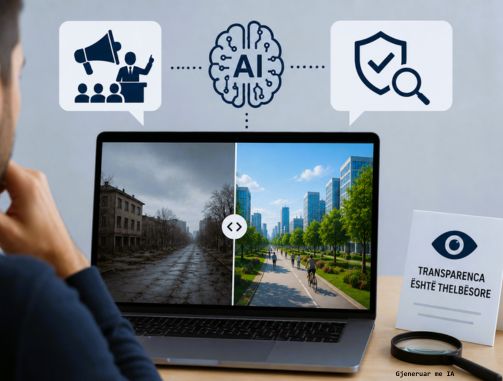

Political actors have created and are creating electoral content generated with artificial intelligence (AI) during the early national election campaign.
Continuous monitoring has confirmed that there is a risk that such content will be taken as truth by the audience. This risk also exists during the election campaign, with political actors using AI content to present electoral promises, but also about the current social and institutional situation.
AI is becoming a powerful tool for political communication. AI-generated content simplifies the message, makes it more understandable and closer to the public. It has an emotional impact on a part of the audience, which is inclined to take it for granted. In many cases, their goal is not necessarily to deceive citizens, but to build a visual narrative that supports political discourse — whether to highlight the shortcomings of the present or to promote an ambitious vision for the future.
For this reason, the ethics of public communication require complete transparency, making it clear that this is synthetic content and not real footage or direct evidence from the field.
While it would be good for such content to be labeled as AI-generated content, this is not legally regulated in Kosovo. Hibrid.info has consistently advocated for increased transparency and the establishment of clearer mechanisms for managing AI-generated content.
On January 30, 2026, the discussion table "Information integrity and artificial intelligence", where representatives of public institutions, media, academia and civil society discussed the growing impact of artificial intelligence-generated content on the public information ecosystem in Kosovo, the challenges it poses for the media and existing regulatory gaps. The discussion emphasized the need for clear standards of transparency and ethics, while the panelists assessed that the problem does not lie in the technology itself, but in the lack of regulation and responsibility in its use.
How is this fixed?
In this regard, the European Union's regulatory framework, through the AI Act, places transparency at the heart of its approach. According to Article 50 of this act, content that is generated or manipulated by artificial intelligence systems and that can be confused with reality — especially images, videos and audio materials — must be accompanied by clear notices indicating that they have been created or modified with AI. The aim is clear: to avoid misunderstandings and to make citizens aware of the synthetic nature of the material they consume.
Beyond the AI Act, the European Commission has also addressed this issue through Recommendation 2023/2829 for inclusive and resilient electoral processes. The document calls on political parties, candidates and campaign organizations to adopt codes of conduct that promote electoral integrity and to avoid the use or distribution of fabricated, misleading or AI-generated materials that could distort public debate. In particular, the recommendation identifies deepfakes as a risk that should be addressed through self-regulation and transparency standards.
In the same breath, Code of Conduct for the 2024 European Elections, supported by the European Commission and International IDEA, requires political parties not to produce, use or distribute deceptive content, including audio, images or videos generated with or without AI, that falsifies candidates, officials or other electoral actors. According to this code, the use of content generated with artificial intelligence is considered acceptable only when it is clearly identifiable and labelled as such. The code also addresses the use of fake accounts, bots, trolling and other forms of digital manipulation that can undermine democratic processes.
Another important instrument ështe Regulation (EU) 2024/900 on the Transparency and Targeting of Political Advertising. It requires that citizens be clearly informed about who is behind a political advertisement, why they are being targeted with it, and whether artificial intelligence has been used in its targeting or delivery. These obligations are not limited to parties and candidates, but also extend to organizations, foundations, influencers, and supporters acting on their behalf.
Therefore, the use of artificial intelligence in political communication can only be considered acceptable when accompanied by visible transparency mechanisms — clear labels, declarations or explanations — that make the nature of the content understandable. Otherwise, there is a risk of creating a fabricated reality that shapes public opinion without the full awareness of citizens. Such a practice conflicts not only with the ethical principles of public communication, but also with the transparency standards provided for by the European Union’s AI Act and with the self-regulatory approaches being promoted by media actors in Kosovo.