
On Facebook, on the account of Hekuran Murati, the acting Minister of Finance, a post where economic growth (5.43%) is presented for the first quarter (Q1) of 2026. The post compares this figure to a "regional average" of 2.86%, without specifying a single source as to where this average was derived from and which countries were included in the calculation.

Although the figures for Kosovo in this post are officially accurate, the way they are presented exposes us to a phenomenon known as “Cherry-picking” (see here).
What is “Cherry-picking”?
To understand this phenomenon, we will refer to a the article of Global Fact-Checking. “Cherry-picking” (literally from English “cherry picking”) is a method of argumentation based on the selective use of information, where only those data that support the desired conclusion are taken into account, while information that contradicts or complements it is ignored.
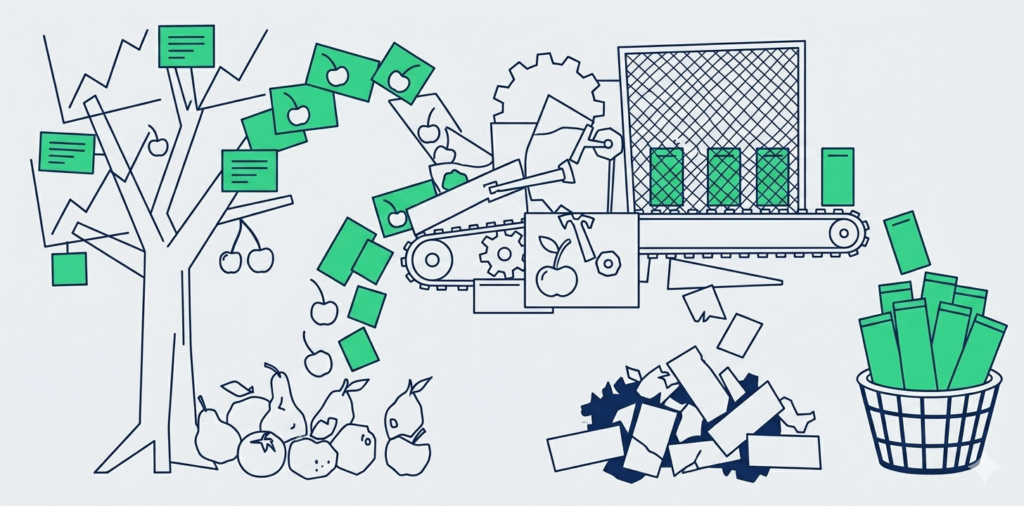
The illustrative example used in the article is a farmer who harvests cherries. As it says, he takes only the ripest and juiciest ones, while leaving the rest on the tree. It goes on to say that when you look at his full basket, you might think that the entire produce is of that high quality. But in reality, that basket represents only a fragment of the total harvest.
According to the Global Fact-Checking article, selective reporting is a manipulation that works by obscuring context. This technique allows for "verification" of anything without having to invent lies.
Where can “Cherry-picking” be applied?
According to the aforementioned article, “Cherry-picking” in politics is used as a strategy to create the illusion of success even in times of crisis. Politicians select only positive figures (e.g. salary increases), hiding the negative data that accompanies them (such as inflation or rising unemployment), or comparing the country only with countries that are even worse off.
The media says we see it in bombastic headlines to attract attention. The media extracts a superficial finding from studies (e.g., “coffee prolongs life”), overshadowing the full conditions, limitations, or risks contained in the full text of the research.
The article further shows that business and marketing manipulate satisfaction percentages without showing context. Advertisements tout high figures (e.g., “90% of customers are satisfied”), but hide the small sample size (it could be as few as 9 out of 10 people) or the short time frame over which that rating was obtained.
Why is selective presentation of facts dangerous?
Selective presentation of facts, according to an article by Global Fact-Checking, is dangerous. According to the article, the greater danger lies not in lies, but in distorting the context by overshadowing other data. This practice is said to impair critical thinking by making it impossible to draw informed conclusions, reinforce confirmation bias by encouraging us to believe only fragments that match our beliefs, and replace rational analysis with emotions whenever something simply “sounds good.”
Furthermore, this manipulation creates social polarization and increases our vulnerability to those who control the flow of information, while in the scientific sphere it completely undermines the credibility of research by hiding failures, limitations, or results that contradict the researcher's hypothesis.
Why does “Cherry-picking” work?
The article also highlights that this manipulation is extremely effective because it exploits our cognitive weaknesses. First, our mental laziness that leads us to accept the first emotional “cherry” as truth to avoid verification efforts. Second, confirmation bias, which makes us believe only that information that supports our pre-existing beliefs or fears. And third, the accessibility effect, where dramatic events influence us much more strongly than complex statistics.
Minister Murati's post presented selectively chosen figures without full economic context, used averages or regional comparisons without explaining the methodology, and made a direct connection between economic indicators and political factors without an analytical basis, ignoring the factors that influence economic performance.
How to protect ourselves?
Global Fact-Checking proposes five steps to protect yourself from this form of manipulation.
- Analyze the motives: Ask yourself what is missing? What facts could refute this? Who is saying this figure and why?
- Search for the full view: Don't blindly trust one source and check full reports (like those from the Kosovo Agency of Statistics) to see the historical trend.
- Check the context of the statistics: Always ask how this percentage is calculated? For what period? What other factors (outside of politics) have influenced it?
- Admit your bias.: We are all prone to confirmation bias, so ask yourself, am I trusting this chart just because it aligns with my political beliefs or hopes?
- Distinguish fact from interpretation.: The 5.43% figure is a fact, but the claim that it came exclusively as a result of a vote, or a warning of future failures by the opposition, is simply a manipulative interpretation.