
Wrote: Festim Rizanaj
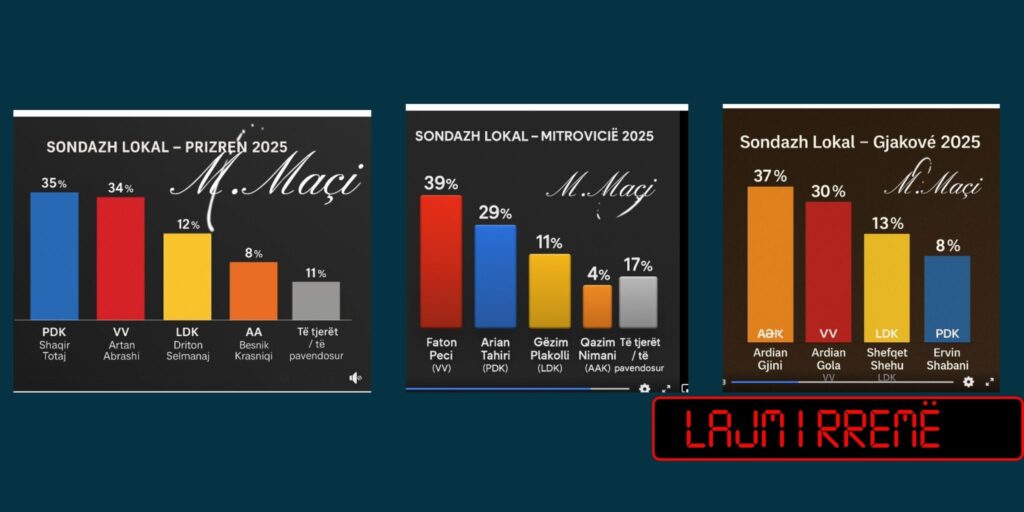
On Sunday, October 12, 2025, the Facebook profile "Murat Maci" published three so-called polls for local competitions in Prizren, Gjakova, and Mitrovica.
The posts are presented in graphical form and with written analysis, but do not contain any data on the methodology used, the period of implementation, or the number of respondents - essential elements to make a survey reliable.
An internet search has not yielded any results from any media or research institution supporting this data, raising serious doubts about its veracity.
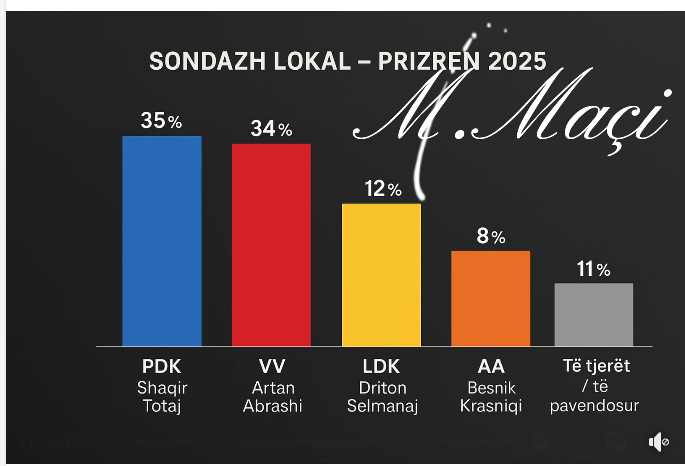
Prizren
According to the “poll”, the race in Prizren appears to be close between Shaqir Totaj from PDK (35%) and Artan Abrashi from VV (34%), while LDK with Driton Selmanaj ranks with 12% and AAK with Besnik Krasniqi with 8%. The publication describes the race as a “head-to-head political duel” and interprets Prizren as a city that is “testing the balance between tradition and change”. (here)
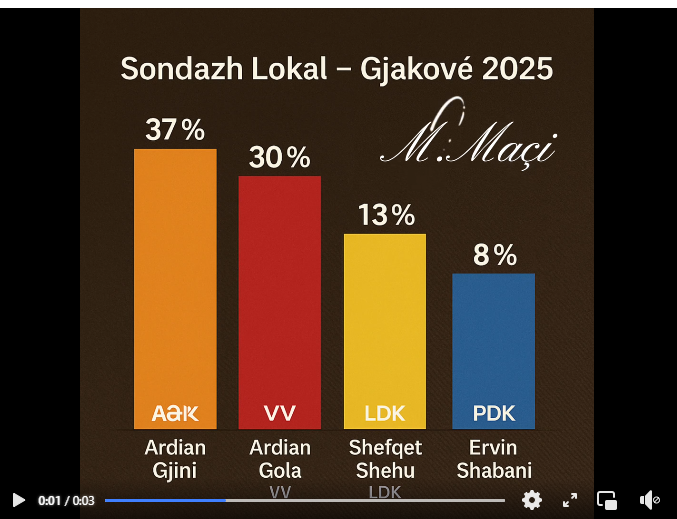
Gjakova
In the municipality of Gjakova, the post claims that Ardian Gjini from AAK leads with 37%, followed by Ardian Gola from VV with 30%. LDK ranks with 13% and PDK with 8%. According to the published analysis, Gjakova is seen as one of the municipalities with the strongest political rivalry, while undecided voters are mentioned as a determining factor. (here)
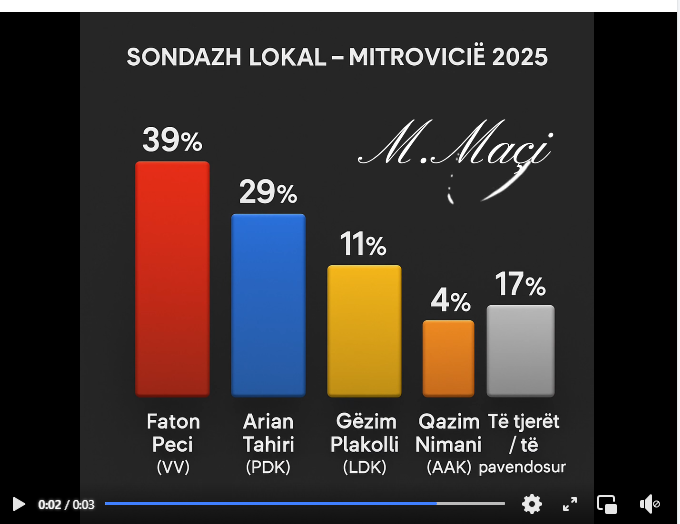
Mitrovica
In Mitrovica, the “poll” puts VV candidate Faton Peci in the lead with 39%, ahead of PDK’s Arian Tahiri with 29%. The LDK and AAK candidates rank low, at 11% and 4%, respectively. The post describes this race as a “clear lead” for Vetëvendosje, but even here it fails to present the basic data that would make the poll credible. (here)
However, a Google search with the keywords used in these publications does not yield any results from any credible media or research institution that supports this data. This means that the “polls” distributed by the “Murat Maci” profile have no verified source and remain unfounded.
Neither of these three publications contain methodology, referenced sources, or transparency on how data was collected, so the results they present cannot be considered reliable.
Analyze:
All three cases are clear examples of the spread of electoral disinformation, through publications that present themselves as polls, but without any factual basis. These claims seem to aim to influence voters' perceptions on election day, creating a false impression of the superiority of certain entities.
The lack of verifiable sources and the use of well-known company names without concrete evidence are clear indicators of information manipulation.
In accordance with its verification methodology, hibrid.info categorizes this content as "Fake News".
rationale
The “Fake News” rating is given to informational content that is entirely fabricated or that contains factually incorrect claims or information. Content that is rated as fake news can be defined as having been created and distributed with the intent to misinform the public, i.e., to present a claim that is completely false as fact.