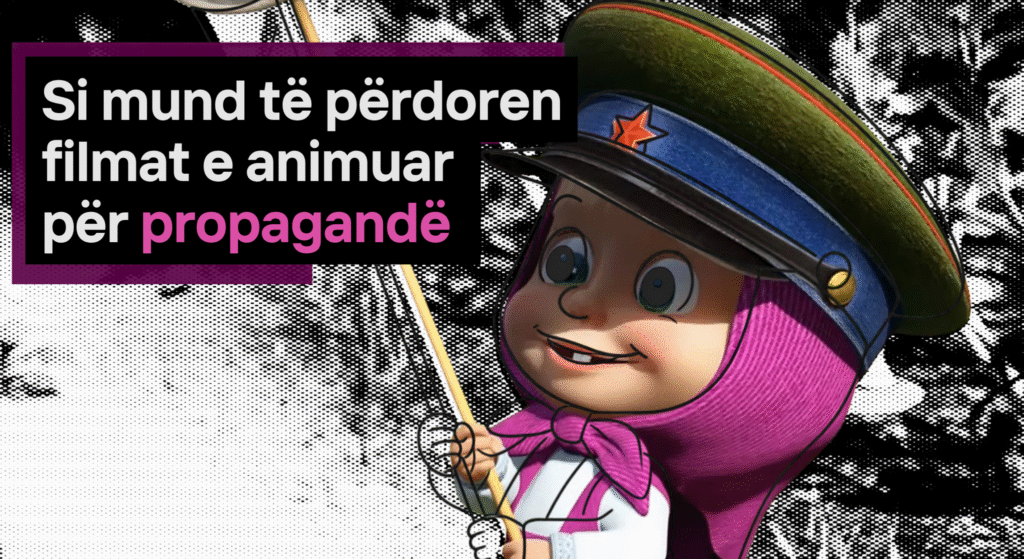

A little girl, a bear, adventure and humor. At first glance, Masha and the Bear looks like an ordinary children's series. But on August 20, 2026, Ukraine imposed sanctions on the Russian studio Animaccord and several individuals associated with the production and distribution of the series (see here). Ukrainian authorities have accused the series of spreading pro-Russian narratives disguised as children's content. According to the Ukrainian Ministry of Culture, the sanctions create a legal basis for blocking the content in Ukraine and for seeking restrictions on monetization and distribution on international platforms.
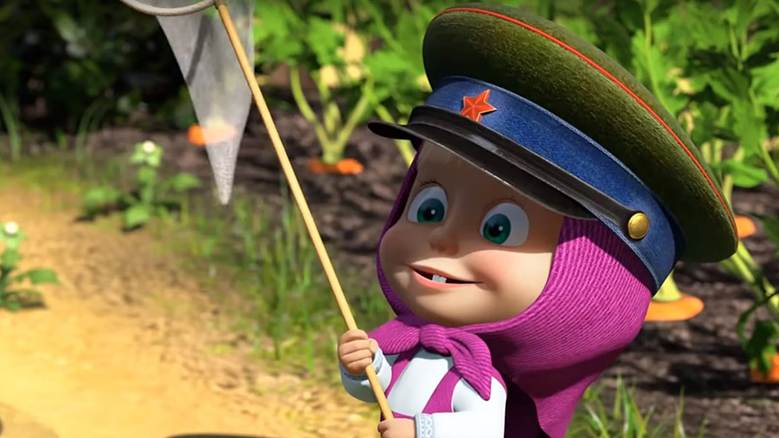
The Ukrainian decision did not come without a previous debate. In July, more than 50 British MPs from different parties urged the government to consider banning the series from being broadcast in the United Kingdom. They claimed that some episodes contain Soviet military imagery and that this could normalize symbols associated with the Soviet regime among children (see here).
The series' producer has denied these allegations. Animaccord says it is a private company, that it has not received state funding, and that the series contains no political messages (see here).
So, the fact that Ukraine has sanctioned the series does not automatically mean that it has been proven that the series is propaganda. But, a broader question arises here:
Can entertainment be used to convey political, ideological, or cultural messages without appearing like propaganda?
Propaganda doesn't always look like propaganda.
When we talk about propaganda, we usually think of political speeches, posters, election ads or direct messages.
But propaganda can also be built through stories.
A film doesn't need to directly say that one country is “good” and another is “bad.” A narrative can be built through characters, conflicts, symbols, and the way heroes and antagonists are presented.
For this reason, cartoons have long been the object of study in the context of propaganda.
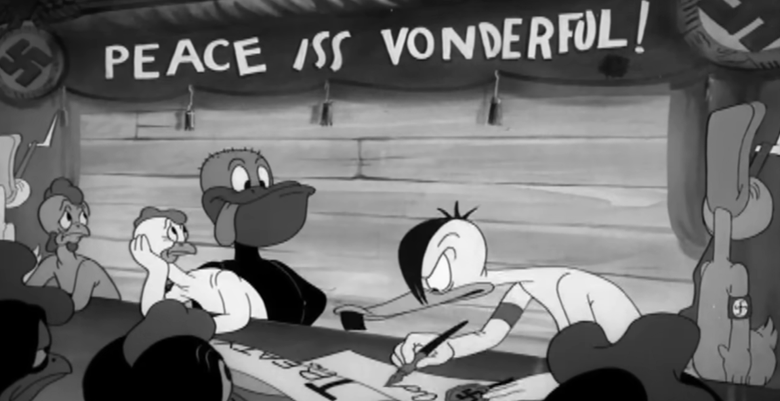
A study by James Stanley Machowski and James William Brown analyzed 194 of the 262 Warner Brothers cartoons produced for theaters between 1939 and 1946, examining the use of symbols and the films' attitudes toward them. The researchers found that, in most cases, the propaganda elements were intertwined with the main action of the film, rather than being its sole message. The United States and its allies were portrayed positively, while characters identified with the enemy were portrayed negatively (see here).
This shows that the propaganda message does not necessarily have to be the main theme of a film. It can just be an element within a story that, in the first place, aims to entertain.
A historical example from Hollywood
World War II provides many examples of the use of animation for propaganda purposes.
The study of Warner Brothers films shows that the main characters identified with the US, winning the conflicts, while the Germans and Japanese were often presented through negative stereotypes.
An analysis by The Guardian on the history of propaganda in cartoons also mentions the use of animation by studios such as Warner Brothers and Disney during World War II, while noting that the Axis powers also used animation for their messages (see here).
Thus, the phenomenon cannot be reduced to a single state or conflict. Animation has been used in different periods and contexts to construct images of “us” and “them”, of hero and enemy.
Why can entertainment be a powerful tool?
An important part of animation's power lies in the way it simplifies reality.
A complex conflict can be transformed into a comprehensible story. One character is the hero, another the antagonist; one is brave, another a coward; one protects the good, the other threatens it.
In this way, the audience doesn't just receive information. They receive a story through which they interpret the information.
In Machowski and Brown's study, visual and audio symbols, character behavior, and interaction patterns were analyzed.
This shows that, to analyze a film as potentially propagandistic, it is not enough to look for a sentence that says "Russia is good" or "America is good."
When children become the audience
Animated series are not just a form of entertainment, but a powerful pedagogical and socialization tool. STUDY of 2025, “Exploring the Role of Animated Cartoons in Promoting Values and Social Skills in Children” emphasizes that through the stories, humor, and conflicts that appear on screen, cartoons directly contribute to the social, emotional, and cognitive development of children.
This is important because socialization doesn’t just happen through formal schooling. Children learn about the world, ethics, and social relationships through the role models they constantly see in their favorite characters. As the study notes, character-based storytelling fosters empathy, cooperation, and moral reasoning, turning animation into a form of “narrative pedagogy.”
However, one should avoid concluding that the fact that children are exposed to values and behavioral models on screens does not mean that they receive the messages blindly or passively, as their influence remains a complex process that depends on many other factors.
"Masha and the Bear" and "soft power"
In the case of Masha and the Bear, there is also specific academic literature.
In 2020, scholar Vlad Strukov published the chapter “(Masha and) the Bear Diplomacy: Soft Power as World-building and Russian Non-governmental Agency” in the book Cinema and Soft Power: Configuring the National and Transnational in Geo-politics.
Strukov analyzes the series in the context of "soft power”, focusing on digital animation, modes of distribution, and how the series constructs a cultural world. He also notes that Russian cultural successes, including Masha and the Bear, have been interpreted by some Western observers through the concepts of propaganda and information warfare (see here).
But, Soft power is not the same thing as propaganda.
A cultural product can increase the attractiveness of a country without necessarily being a state-controlled propaganda product.
Precisely for this reason, Masha and the Bear is an interesting case for analysis, as there is already a real debate about the cultural and political role of the series, while the producers themselves deny its propagandistic character.
Is every film propaganda?
A political symbol or a negative character does not automatically make a film propaganda, just as a film originating from a state does not automatically make it an instrument of that state. For this, one must look at the content, context, funding, and evidence of intentional influence.
Therefore, the question is not simply “Is this film propaganda?”, but: What narrative does it convey, what values does it normalize, and is there evidence that it was used intentionally?
Because propaganda doesn't always look like propaganda. Sometimes it comes as a speech, sometimes as an advertisement, and sometimes even as a cartoon.