
According to data published by the European Statistical Office (Eurostat) on 17 June 2026, 29.2% of people aged 16–74 in the European Union (EU), during 2025, tried to verify the authenticity of information or content they had encountered online, using other sources (see here).
The data was published as part of statistics on the use of digital technologies.
The data shows differences between European Union countries. Ireland leads with the highest percentage of people who have tried to verify information online, at 63.6%. It is followed by the Netherlands, at 53.1%, and Luxembourg, at 45.2%.
On the other hand, Greece records the lowest percentage, with 9.8%, followed by Lithuania with 14.9% and Romania with 18.2%.
The Western Balkan countries are also included in this statistic. According to Eurostat data, North Macedonia has the highest percentage in the region, with 24.22% of people having tried to verify information online. It is followed by Montenegro, with 21.43%, Bosnia and Herzegovina with 18.02%, Albania with 14.34% and Serbia with 11.13%.
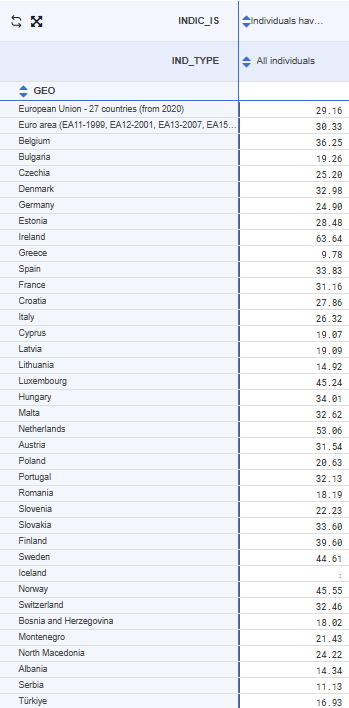
These results show that all countries in the region for which data are available rank below the European Union average of 29.2%. There is no published data for Kosovo for this indicator in 2025.
It should be noted that this indicator measures citizens' efforts to verify information through other sources and does not directly represent their ability to distinguish accurate from inaccurate information, or the level of exposure to disinformation.
In a digital environment where information is rapidly distributed, verification through other sources remains one of the important practices for critical information consumption.