
Authors: Etrit Rexhepi and Fatbardh Dema
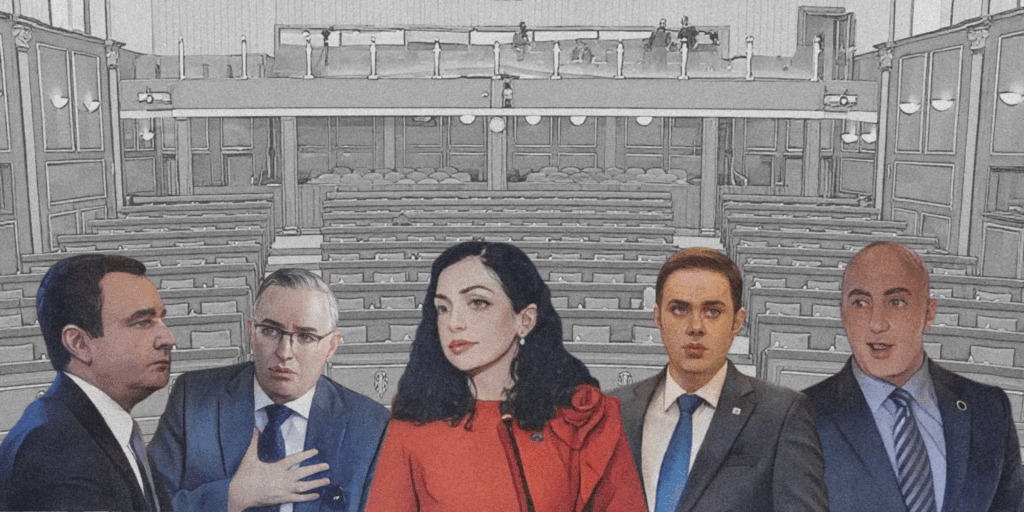
President Vjosa Osmani's decree to dissolve the Kosovo Assembly has sparked political and social debate. Based on previous practices, not so long ago, with the increase in political clashes and electoral periods, there has also been an increased volume of misinformation circulating.
Initial event
On March 6, President Osmani issued a decree dissolving the Parliament, after MPs failed to elect a new president by March 5. In a conference Speaking to the media, she said that she makes the decision based on Article 86 of the Constitution of Kosovo, in conjunction with Article 82.
The media reported with correct headlines announcing that Osmani had issued a decree dissolving the Parliament.
"Irresponsible people with dangerous intentions"
Another part of Osman's statement also received attention:
"Of course, the citizens did not want elections. This situation was created by the failure of the Assembly to fulfill its constitutional duty. No one should want another political cycle. Especially at this moment when the country needs stability, but irresponsible people with dangerous intentions brought the country to this point."
While Osmani did not specify names, some media and social media users interpreted this as Osmani's stance referring to the leader of the Vetëvendosje Movement (LVV), Albin Kurti, and his party, which was in power (see here, here, here and here (archives)). Publications regarding Osman's statement have generated thousands of comments on social media.
Following these reports, Vetëvendosje officials were questioned about this statement in two conferences. The head of the LVV Parliamentary Group, Arbërie Nagavci, demanded that Osmani come forward with names and surnames for this claim (see here).
Meanwhile, the chairman of LVV, when asked about this issue at the press conference, a few hours after Osman's decision, said:
"If the President didn't mention names, I don't know why you're thinking of me... If we're talking about general impressions, that's one thing, but if we're talking about specific people, I don't know that we were mentioned there. If you're right, I still believe that the answer should be sought in those who said it and not in guessing who they might be. And in the end, "I believe that those who were absent last night were irresponsible."
At this conference, Kurti opposed the dissolution of the Parliament by Osmani. He said that the LVV will take the decree to the Constitutional Court. Kurti criticized the opposition for the failure to elect a new president. Meanwhile, when asked if new elections are held, he said that they are not a solution.
Part of Kurti's statement from this conference was, however, misinterpreted by some media outlets. The claim that Kurti said that if there are new parliamentary elections he will get 80 MPs was incorrect and hibrid.info assessed this content as disinformation (see here). These claims have also received thousands of comments on social media.
Blame for the failure to elect the president
In addition to Kurti blaming the opposition parties, the Democratic Party of Kosovo (PDK) and the Democratic League of Kosovo (LDK), for failing to reach an agreement on electing the president, the head of the LVV Parliamentary Group, Arbërie Nagavci, did the same.
According to her, the opposition was barricaded with a "no" on the issue of proposing candidates, staying in the hall, voting for any candidate, or even on the possibility of constitutional amendments to allow the president to be elected directly by popular vote (see here).
Meanwhile, the leaders of the opposition parties, after the meeting called by Osmani to set the date for new elections, accused the Vetëvendosje Movement and its leader Albin Kurti of blocking the presidential issue.
PDK Chairman Bedri Hamza said that the failure to elect the president "the main responsibility lies with the winning party, the largest party". "She could have given the country a president.", he said (see here).
The leader of the Alliance for the Future of Kosovo (AAK), Ramush Haradinaj, said that the absence of Vetëvendosje in the meeting with Osmani "It is an insult to the country, to Kosovo, to the institutions." (see here).
Before the meeting, the chairman of the LDK, Lumir Abdixhiku, said that "appetites for one-party capture of all state positions prevented any eventual compromise" (see here).
Commentators "follow" party leaders
In the spirit of polarization between parliamentary political parties, the same is also being observed among commentators on social networks.
Commentators were divided on the video of the statement made by the head of the LVV MPs, Arbërie Nagavci. Some of the 57 comments made support Nagavci's statement, however, a large portion of them oppose it.
There are those who say "never again with Vjosa Osmani"and "except with Albin as prime minister", but most are opposed to the LVV's position, saying "I will never vote for Albin Kurti again.","don't lie","you will get slapped by the people", and others like it - blaming this party for the institutional blockade.
There are not many comments on Hamza and Haradinaj's statements (5 in total from the same account), while on Abdixhiku's post on his Facebook profile, there have been many comments – 337 of them. Although some of them are in support of the party he leads, there are others who demand the return of Vjosa Osmani to LDK, assessing that with her return the "great return" of the party will occur. There are also commentators who see the opposition as blocking the processes and the LDK itself as the party that risks crossing the threshold in the upcoming elections.
What preceded the discussions and what does the Constitution say about the deadlines for electing the president?
On March 5, the Assembly failed to elect a new president in an evening session. There was not a sufficient quorum of at least 80 deputies in the Assembly to begin the first round of voting to elect the president (see here)
The current president's term ends on April 4, 2026 (see here).
CONSTITUTION in Article 86, paragraph 2, specifies: The election of the President of the Republic of Kosovo must take place no later than thirty (30) days before the end of the term of office of the current President.
Meanwhile, Article 82, paragraph 3, states that The Assembly may be dissolved: if, within sixty (60) days from the date of the commencement of the election procedure, the President of the Republic of Kosovo is not elected.
President Osmani said that the word "must" in Article 86.2 specifies that in the current case "March 5 was the constitutional deadline for the Assembly to elect the new president."
Meanwhile, Kurti, based on Article 82.3, said that "60 days have not passed since the start of the procedure" for the election of the president and that by the end of this term "There is no constitutional basis for the dissolution of the Assembly."
After the failure to elect a president on the evening of March 5, Parliament Speaker Albulena Haxhiu reported that it has requested from the Constitutional Court an assessment of the constitutionality of the procedure for electing the president and a temporary measure to suspend the constitutional deadline, until the publication of the judgment.
So, on the issue of the election of the president and the decree, there are two cases that have been sent or announced to be sent to the Constitutional Court.
Misinformation before March 5
After the certification of the parliamentary elections on December 28, the constitution of the Assembly was quick and then the formation of the government on February 11, 2026. But this paved the way for various reports, publications, and claims related to the process of electing the new president.
Osmani said on December 29th about "Radio Free Europe"that she intends to run for president again. Her declaration of a possible candidacy for a second term placed the issue of electing the president at the center of political and media discussions. In this context, the topic of the Presidency began to be discussed not only at the institutional level, but also in the public space through various reports, analyses and interpretations. In addition to legitimate discussions, misinformation also began to appear in the digital space. It is precisely some of these cases that became the subject of treatment by hibrid.info.
The dominance of the presidential issue is confirmed in the misinformation monitoring report for January 2026. The position of the president was the most used topic for the creation and distribution of misinformation content in the month in question (see here).
From the published treatments it results that, since the beginning of this year, hibrid.info has treated at least 20 articles directly related to the presidential election process and the figure of President Vjosa Osmani. Each of these articles was categorized according to hibrid.info's evaluation methodology. Eight of these contents were assessed as "Fake News", while the categories "Disinformation" (here, here and here) and “Manipulation of facts” had three cases each (here, here and here).
In addition, two pieces of content were classified as “Clickbait” (see here and here), while two others received a combined rating of “Fake News/Hoax” (see here and here).
A combined rating was also given to two other pieces of content, such as “Fact Manipulation/Disinformation” and “Disinformation/Clickbait” (see here and here).
In addition to President Osmani, other political figures are often mentioned in the content discussed, such as Prime Minister Albin Kurti (here and here), LDK leader Lumir Abdixhiku (here, here and here), AAK leader Ramush Haradinaj (here and here), the mayor of Skenderaj Municipality, Sami Lushtaku (here), LDK spokesman Besian Mustafa (here) and LDK official Lutfi Haziri (here).
In some cases, international figures such as the President of the United States of America (US), Donald Trump, are also included. Elon Musk has also been mentioned in the context of an artificial intelligence-generated image, which claimed a non-existent meeting (see here and here).
Misinformation during 2025: The Year of Elections and (Non)Formation of the Government
During 2025, the issue of political elections dominated the misinformation covered by hibrid.info. Within the year, the state organized three sets of elections, two parliamentary ones on February 9 and December 28, and local ones in October (and a runoff in November).
Tall January 2025, the misinformation was mainly related to the parliamentary elections in Kosovo, accounting for 48% of the cases handled by hibrid.info. The claims included pro-Kosovo Liberation Army (KLA) and Hashim Thaçi chants falsely linked to the Vetëvendosje Movement, false claims about Kurti’s campaign in North Mitrovica, as well as manipulated poll results. In addition, fake news was spread about well-known figures such as Rifat Jashari, Shefqet Krasniqi, and Donald Trump, falsely attributing support to Kurti.
in February 2025, election topics continued to dominate with 43% of misinformation content from the field of politics. Fake news and disinformation included false claims about Fatmir Limaj, American generals, old photos used as current news, manipulated videos about Trump and Elon Musk, as well as claims of false election results and imaginary political meetings.
Tall March 2025, misinformation regarding the formation of the government was published mainly on social media and included disinformation and fake news. Among the main cases was the claim that Marigona Geci had said that the LDK would vote for Kurti's government, as well as false claims about Lumir Abdixhiku's statements about leadership positions.
in April 2025, misinformation continued as fact manipulation, fake news, and clickbait, spreading inaccurate claims about the inclusion of the Serbian List in the coalition, statements by Russian Foreign Minister Sergei Lavrov, as well as fabricated news about a coalition between Vetëvendosje and NISMA.
Tall May 2025, all content handled by hibrid.info was related to politics and was published on social media, including fake news and manipulation of facts. The most prominent cases included false claims about Milan Radoicic for coordinating with the opposition and manipulation of Abdixhiku's statement regarding co-government with PDK.
in July 2025, the cases included misinterpretations of statements by the then acting Minister of Finance, Hekuran Murati, false claims about Fatmir Limaj's requests, and errors in reporting the Osmani-Kurti reports.
Tall August 2025, misinformation about local elections included clickbait, unproven claims about a burned car, and double-barreled misinformation about statements by politicians from the Serbian List. This content was intended to attract clicks and create an inaccurate perception of local security and political activities.
in September 2025, political misinformation (43%) was published mainly on social media (37%) and online (6%). Frequent categories included fake news, manipulation of facts and disinformation. Key cases included unreliable polls for candidates in the municipalities of Ferizaj, Lipjan, Gjakova, Podujeva, Deçan, Kaçanik and Viti, as well as false statements against public figures such as Alban Hyseni, Agim Veliu and Shpejtim Bulliqi.
Tall October 2025, misinformation content about local elections accounted for 66% of cases, mainly fake news, fabricated polls, biased reporting and manipulation of facts. Publication was carried out mainly on social media (47.37%) and traditional media (18.42%). For the topics of northern Kosovo, Kurti-Serbia and the dismissal of the Speaker of the Assembly, the content was distributed in similar percentages between social and traditional media.
Tall November 2025, misinformation about local elections (37%) was distributed exclusively on social media and included fake news (27%), disinformation (7%), and manipulation of facts (3%). The content included images and videos of mayoral candidates, alleged results of polls and exit polls, as well as fabricated statements of support or electoral preferences that did not correspond to reality.
Tall December 2025, misinformation related to the December 28 elections included fake content, unreliable polls, and videos manipulated using artificial intelligence. This content was distributed primarily on social media, aiming to influence public perception and create an inaccurate image of the electoral process and candidates.
What do scientific studies say?
That political polarization leads to tensions, discussions, and even disinformation is supported by numerous international scientific studies.
With the title "Right and left, partisanship predicts (asymmetric) vulnerability to misinformation", Harvard Kennedy School – Misinformation Review published a study in February 2021 (here)
The study addressed the connection between political polarization, echo chambers and the spread of disinformation, by analyzing the news sharing behavior of more than 15,000 users on X (formerly Twitter). The researchers measured users’ political orientation based on the news sources they shared and compared this with the percentage of links from low-trust sources. The results show that political partisanship, the structure of online communities, and vulnerability to disinformation are closely linked, suggesting that highly polarized environments create more favorable conditions for the spread of false information.
One of the key findings is that users on social networks tend to cluster into ideologically homogeneous communities, known as echo chambers. Analysis of the network of followers and distributions in X showed clear divisions into two dense political groups, where users interact primarily with people who share the same political orientation. This polarized communication structure causes information to circulate primarily within ideological groups and less between them, limiting exposure to different perspectives.
The study also shows that vulnerability to disinformation increases with increasing political partisanship. Statistical analysis showed that ideologically stronger users are more likely to share content from low-quality sources compared to more moderate users. Although the phenomenon is observed on both sides of the political spectrum, the study confirms previous findings that the link between partisanship and the spread of disinformation is stronger among users with a political right orientation, while among users with a left orientation it is weaker but still present.
In the final analysis, the researchers found that partisanship is the strongest predictor of vulnerability to disinformation, more so than the echo chamber structure itself. This suggests that strong political identification can influence how people consume and distribute information, increasing the likelihood that false narratives will spread within ideological communities. The authors say that one way to reduce the spread of disinformation on social platforms is to increase exposure to more diverse and less polarized content in the online information ecosystem.
The next study, "Polarization and social media: A systematic review and research agenda" (Arora et al., 2022), has been published in "ScienceDirect".
This study analyzes a large body of academic research on the relationship between social networks and political polarization, showing that the transformation of the information ecosystem by digital platforms has changed the way people receive and share information. The authors emphasize that interactions in online public spaces are often influenced by emotional preferences, biases, and selective interactions, which can lead to polarization and the spread of misinformation. In this context, social networks have increased the speed and scale of information circulation, creating an environment where false narratives can more easily spread within ideological communities.
One of the main mechanisms identified by the literature is homophily – the tendency of people to associate with individuals who share similar political beliefs. In social networks this creates closed information communities, known as echo chambers, where users are exposed primarily to information that reinforces their existing views. This dynamic strengthens the ideological identity of groups and reduces contact with alternative perspectives, thereby increasing political divisions and tensions in public discourse.
The study also shows that recommendation algorithms and content selection on social networks can intensify these processes. Platforms often suggest content to users that matches their prior interests and beliefs, which can deepen ideological and emotional polarization. As a result, online political discussions often become more conflictual and less deliberative, making it more difficult for constructive dialogue between groups with different views.
In conclusion, the systematic review argues that the relationship between social networks and polarization is complex and mediated by multiple factors, but the evidence suggests that digital environments can contribute to the fragmentation of public debate. When information communities become too ideologically divided, this not only increases political tensions and conflicts in public discourse, but also creates favorable conditions for the spread and reinforcement of disinformation within polarized groups.
Based on these studies, previous reports reviewed by hibrid.info, there is a possibility that misinformation will continue to appear in the coming weeks of political uncertainty and on the eve of potential parliamentary elections.
Therefore, in addition to warning against headlines taken out of context, unfounded claims and manipulated visual content, readers are recommended to consult verified news sources and fact-checking platforms, such as hibrid.info; to check information through reports from official Kosovo institutions, not to distribute news without verifying the source and content, especially on social networks, and to refrain from speculation and comments that are not based on verified documents or statements.
This warning aims to help readers follow the presidential election process in an informed manner, minimizing the impact of misinformation on public perception.