
Wrote: Etrit Rexhepi
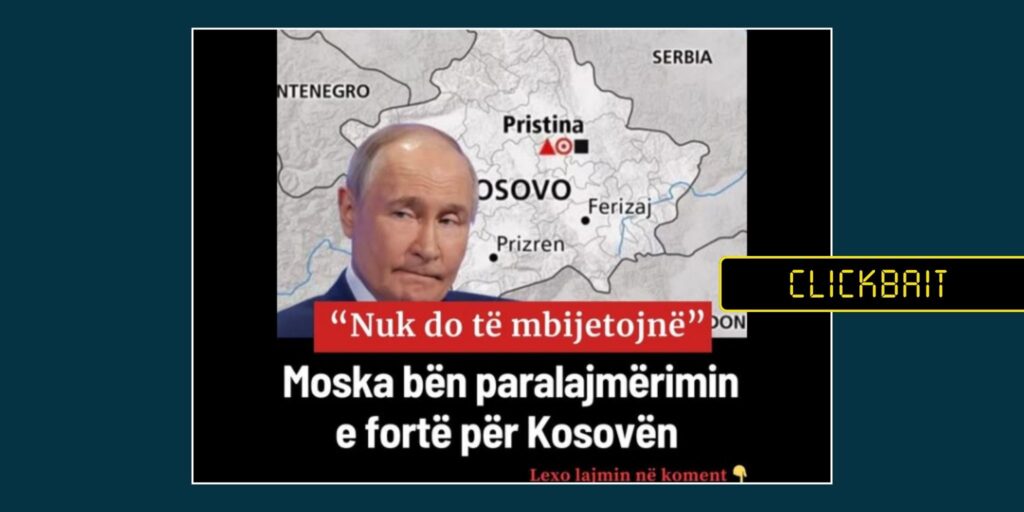
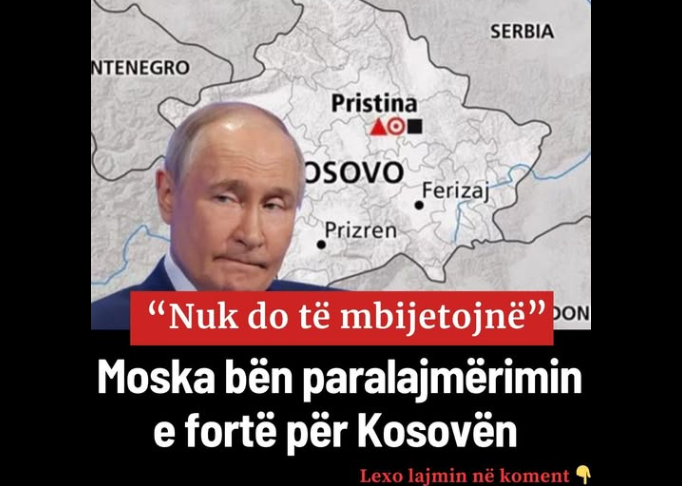
A photo is published with the caption "Moscow issues strong warning for Kosovo, 'They will not survive'".
The image, which also features a photo of Russian President Vladimir Putin, was posted on Facebook on Monday (November 17) by pages with the names "In Albania","miracle”And“Albania".
What's wrong with this inscription?
Hibrid.info has found that the warning mentioned in this content was not addressed to Kosovo.
These posts that published this image have attached a link to an article published on a suspicious portal, "zodyakburcu.com".
LINKS has the article titled "BREAKING NEWS – Moscow issues strong warning for Kosovo – Details".
Based on the content of this article, it appears that the statement as such was not made by Russian President Putin at all, but rather by the Russian ambassador to Belgrade, Alexander Bochan Kharchenko. However, he made the statement in the direction of Serbian politicians, telling them that "a politician who would impose sanctions on Russia and recognize Kosovo's independence "would not be able to survive at the helm of Serbia." So, it was not addressed to Kosovo, but to Serbia for Kosovo.
Full article
"The Russian ambassador to Belgrade, Alexander Bochan Kharchenko, has issued a strong and coded warning to Serbian President Aleksandar Vučić. He said that a politician who would impose sanctions on Russia and recognize Kosovo's independence "would not be able to survive at the helm of Serbia." This statement, without a clear address, seems to be a direct message to the Serbian leadership."
The title part of the photograph, "Moscow issues strong warning for Kosovo" creates the impression that Russia is addressing Kosovo directly, while the red text "They will not survive.”, being placed as a quote, seems like an addition or continuation of the alleged warning in the title.
Based on the content of some of the user comments in these publications, it can be assessed that the audience is likely to read the claim as a warning from Russia towards Kosovo, especially when the face of Russian President Putin is placed in the photo.
Additional research shows that this statement by the Russian ambassador was initially made public earlier, during August of this year (see here and here).
Analyze:
The photo with the caption "Moscow issues strong warning to Kosovo, 'They will not survive'" creates the impression that Russia has given a message to Kosovo.
However, this is a statement by the Russian ambassador to Belgrade, Alexander Bochan Kharchenko, who addressed politicians in Serbia that if they impose sanctions on Russia or recognize Kosovo, they will not be able to survive in the leadership of the state - so it is not a message addressed to Kosovo.
Even readers have misunderstood it as a direct message to our country.
Therefore, based on its work methodology, hibrid.info evaluates this content as "Clickbait".
rationale:
“Clickbait” is considered to be informational content whose title is general and does not disclose the location of the event, context and relevance. Such texts and articles aim to attract the attention of the audience with sensational headlines with misleading consequences, which do not accurately clarify the content of the article. “Clickbait” headlines are mainly made to attract readability in the case of media publications and/or to earn from clicks in the case of commercial publications.