
Authors: Etrit Rexhepi and Fatbardh Dema
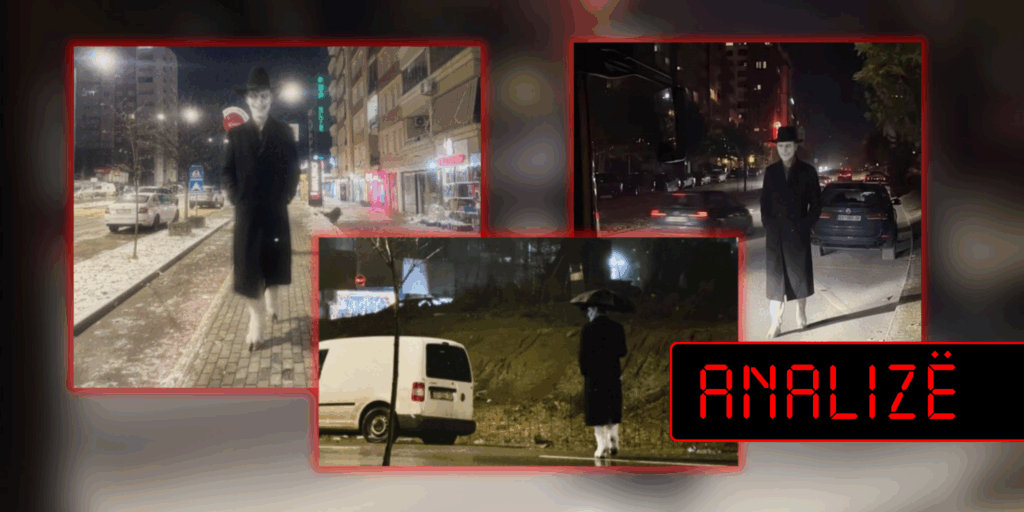
An image that has been circulating widely on social media for the last two days is that of what is now known as the "Ghost of Pristina".
In the first images that the hibrid.info team has managed to find online of this "ghost", a tall body is seen, dressed in a long black coat, with a masked face, a black hat, and instead of feet, it has hooves that resemble those of animals.
This image quickly spread online, and there were even media outlets that reported on it.
Media "Signs" on Sunday (January 11) published on its official Facebook page a photo news about this "ghost" with the caption: ""The Ghost of Pristina" - A masked person wanders the streets of the capital at night".
In addition to the caption they had placed on the photo of the "ghost", the description reads: "Citizens complain that this masked person is 'terrifying' them with his appearance by stalking them at night."
The same claim was made by "Kosovar Magazine", while other sites such as "Revista Ora" and "Qendra Info" have also issued unverified claims about the "Ghost of Pristina" (here and here archives).
What's wrong with these reports?
Various media and Facebook pages, such as "Sinjali", "Revista Kosovarja", "Revista Ora" and "Qendra Info", made these publications without any prior verification of the content in question, prompting numerous comments and reactions.
In addition to various media and websites that usually publish news, other social media users also wrote and published about this figure, mainly on Facebook (here) and TikTok (here and here).
The allegations mainly spoke about the "ghost" circulating on "Street C" in Pristina.
Meanwhile, social media users "sent" the "ghost" to other parts of the city, as well as to other cities in the country. (here, here, here)
However, the first image that hibrid.info managed to find published online differs from the images that subsequently circulated on the network.
In the first image, the figure is seen to have furry legs and animal feet, while in other images, the "ghost" figure is seen to be wearing white pants, and the face also differs from image to image.
There are other social media users who used this image for sarcasm, but also for marketing.
The Kosovo Press Council (KPC), through a public response, criticized the media for reporting on this phenomenon, while saying that the images were created with artificial intelligence..
"Reporting in some media about a "ghost" "walking" through the streets of Kosovo is incorrect, as it is content generated through Artificial Intelligence (AI)."
"The Kosovo Press Council (KPMC) has received concerns from citizens regarding this content."
"The media should be careful to verify similar content and not distribute it, because it could cause panic."
"The KMC calls for reports to be careful, correct and based on the Code of Ethics." (here)
However, as will be seen later from technical verifications, this assessment by the KMShK, that the image was generated with AI, cannot be confirmed with complete certainty.
Hibrid.info has used several platforms to verify the authenticity of the image, in order to determine whether the photo is real, generated with artificial intelligence, or manipulated through other editing applications.
However, the results do not provide firm conclusions.
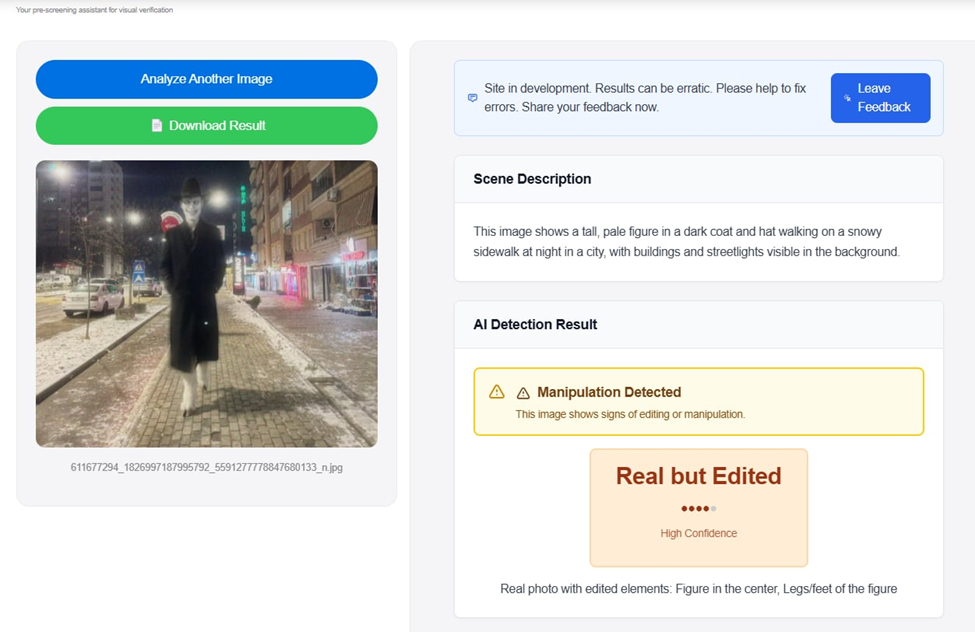
"ImageWhisperer.org" is a media verification platform, which qualifies the image of the "Ghost of Pristina" as a real photo, but with interference - therefore a manipulated image.
"Realistic photo with edited elements. Figure in the center, legs/feet of the figure", it says in the results provided by "ImageWhisperer".
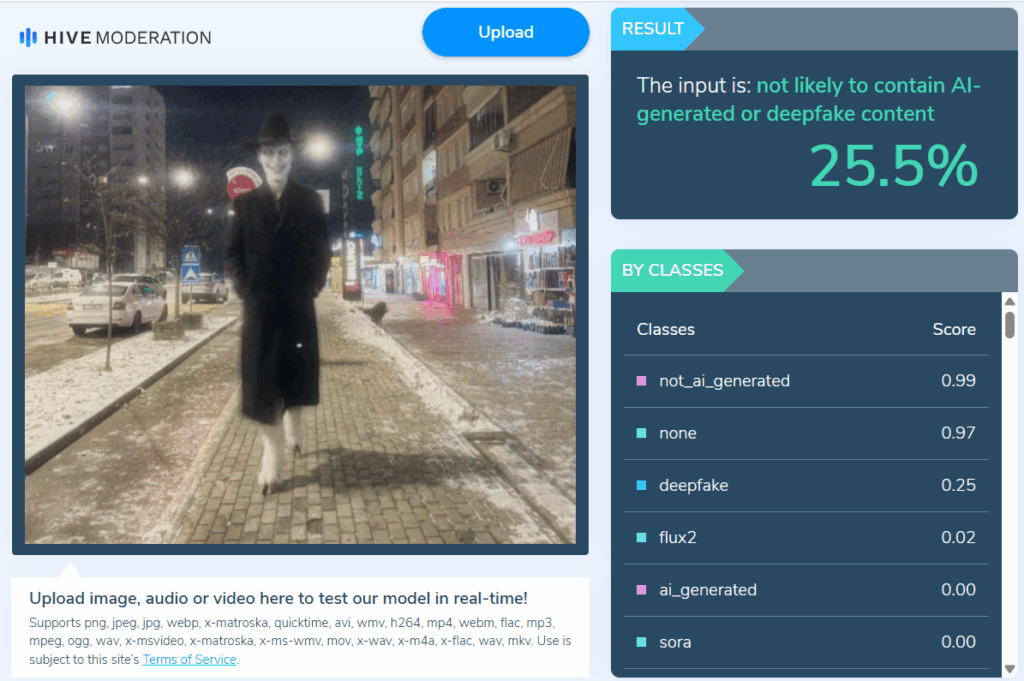
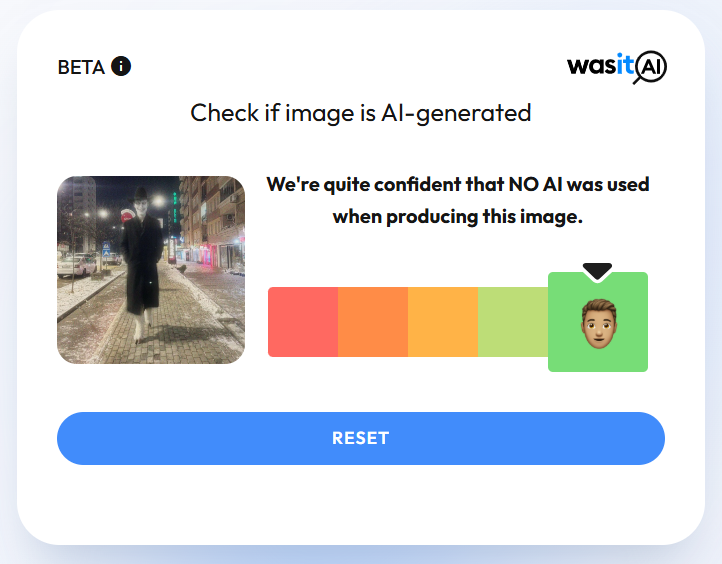
Meanwhile, other platforms used to detect the use of AI in images, such as "HiveModeration", "WasitAI", give different results. The first says that the potential for the image to be generated with AI is 25.5%, while the second says that it was not generated with AI.
Consequently, the photo published on January 10 on social networks cannot be said with certainty whether it was created with artificial intelligence or some other photo manipulation application.
Meanwhile, other images that followed the one on January 10 were found to have been created with AI image generation platforms.
The sociological aspect of the distribution of this image
Sociologist Ambera Kelmendi also spoke about the image in question on the show "Ora Shtatë" on Klan Kosova. She called the use of this character as a marketing and humor phenomenon worrying, however, according to her, children and certain people such as pregnant women, or anyone else, could have suffered trauma from fear.
"We are a people who are used to always being under the tension of something, and we believe everything that is served to us. I was worried about the children's worries. I thought that at night they might see their parents on the second or third shift, they might be alone in their homes for 1 or 2 hours. I thought about some pregnant mothers who might go out to do work in the late evening hours," she said.
Meanwhile, the image's widespread online presence has also prompted comparisons with mythological creatures.
"The Ghost of Pristina" and Centauri
Centaur (Centaur) is a mythological creature from Greek legends, depicted with the head, arms, and torso of a man joined to the body and legs of a horse. It often symbolizes ferocity and instinct, but also wisdom and knowledge.
The importance of pre-publication verification
The so-called “Ghost of Pristina” case is a clear example of how quickly unverified information can spread, especially when it is accompanied by images that arouse fear, curiosity or sensation. At a time when social networks and artificial intelligence tools are increasingly used to create and manipulate content, the responsibility for accurate reporting becomes even greater.
The media, but also the users of social networks themselves, should stop one step before publishing or distributing such materials. Verifying the source, comparing information from more than one reliable source, and seeking official clarifications are necessary steps to avoid misinformation. Publishing unconfirmed claims, without facts and without context, not only violates professional ethics, but can cause unnecessary fear and concern among citizens.
Ultimately, this case should serve as a reminder that credibility is built with care and responsibility. Accurate, fact-based, and verified reporting remains the only way to accurately inform the public and maintain public trust in the media and the information that circulates in the public space.