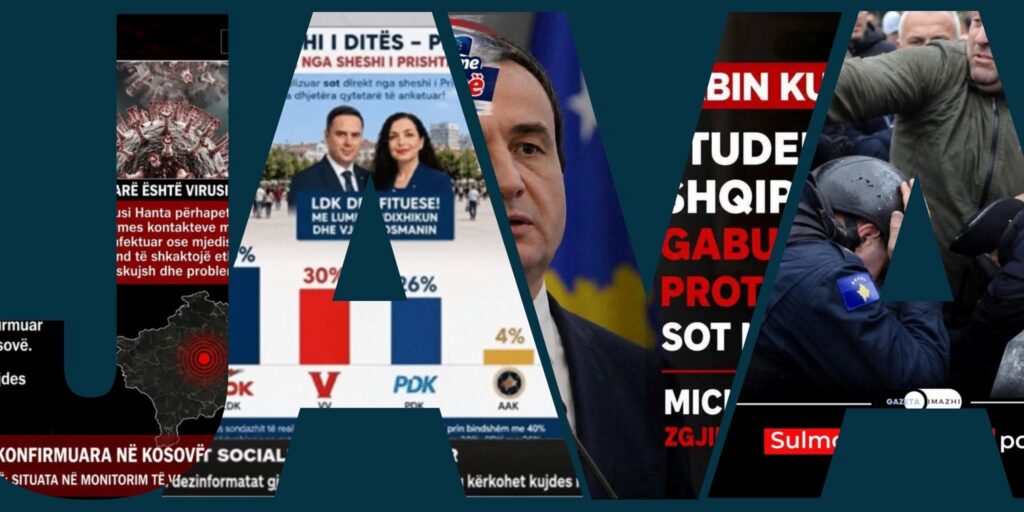

During the period 18–23 May, monitoring of media and social platforms has highlighted a marked dominance of fake news in the information ecosystem. This content has been distributed mainly through social networks and dubious websites, taking advantage of the speed of online information circulation and the lack of verification of sources.
During the period 18–23 May, the fake news identified during the monitoring were published mainly on TikTok and Facebook and dealt with topics related to public health and political developments in Kosovo and the region. One of the most widely shared claims was that of the arrival of hantavirus in Kosovo and the confirmation of the first cases by the National Institute of Public Health, a claim that turned out to be untrue and unsupported by any official announcement. Another false content included the claim that Elisa Spiropali had stated that Vjosa Osmani, together with leaders of the Democratic Party of Kosovo and publicist Baton Haxhiu, had met with Milan Radojičić in Albania, without any evidence to support this claim. A false post was also identified on Facebook that attributed to the acting Prime Minister Albin Kurti a statement regarding the protest of Albanian students in Skopje, a statement that does not appear to have been published in any reliable source.
During this period, the identified cases of fraud have also appeared mainly on social networks and through direct messages, using various forms of manipulation to deceive the public. Some of them were related to the publication of videos on Facebook by the pages “Gazeta Bota” and “PEJA Live”, published on 17 and 19 May, which claimed to present citizens expressing their positions on the June 7 elections in Kosovo. After verification, it was confirmed that these videos were generated with artificial intelligence and did not present real people. Another form of fraud identified during this period was the distribution of fake messages for traffic fines, where citizens were asked to make payments through fraudulent links, being lured with the claim of a 50% discount if the payment was made within 24 hours. These cases show the increasing use of manipulative technologies and phishing schemes to create deceptive content and to incite a reaction or financial gain from the public.
Cases of manipulation of facts and disinformation have focused mainly on political and electoral topics. One of the cases identified was the publication of an image on Facebook on May 20, by the page “Mërgata me LDK-në”, which presented alleged figures of citizen support for political entities, claiming that it was a survey conducted by Kohavision. After verification, it was confirmed that the image had been taken out of context from a KTV chronicle that dealt with the phenomenon of misinformation before the elections, and not the results of a survey. Also, a case of disinformation was identified through the publication of an image claiming that a person was attacking a member of the Kosovo Police in Skenderaj, linking the event to people close to Sami Lushtaku. The verification showed that there is no confirmation of such an incident, while the image used was generated with artificial intelligence. These cases demonstrate the use of visual manipulation and taking content out of context to create false, politically charged narratives and influence public perception.
During this period, cases of clickbait and conspiracy theories have also been identified, which have used sensational headlines and unfounded narratives to attract public attention and incite emotional reactions. In the clickbait category, posts with the title “Blow to citizens, bread price increases, new prices published” have been identified, distributed by pages that usually publish news about Kosovo. However, upon opening the article, it turns out that the news referred to the increase in the price of bread in some bakeries in North Macedonia, and not in Kosovo, causing some readers to misinterpret it as a local development. Meanwhile, in the category of conspiracy theories, a statement by the Office for Kosovo in the Government of Serbia regarding the damage to the doors of an ambulance in Kosovo has been identified, where – although it was said that the act was carried out by unknown persons – it was claimed without evidence that it was a continuation of an anti-Serbian campaign by “Albanian extremists” against Serbs and Serbian institutions in Kosovo. Until the moment of verification, the Kosovo Police had not confirmed either the incident or the possible perpetrators. These cases show how misleading headlines and speculative interpretations continue to be used to distort information and influence public perception about social and interethnic issues.
Fake news
Through posts on TikTok it is claimed that "Hantavirus has arrived in Kosovo" and that the first cases of this virus have been confirmed, attributing a statement to the IKSHPK for preventive measures. However, after verifying the facts, it was confirmed that this claim is untrue. There is no official announcement from the IKSHPK confirming new cases of hantavirus in Kosovo. Also, the content on TikTok has misused the name of Klan Kosova television, as there is no article on the website of this medium reporting on the arrival of this virus in the country. (here)
An image with a caption claiming that Elisa Spiropali, a member of the Albanian Parliament, has stated that former President Vjosa Osmani, along with leaders of the Democratic Party of Kosovo (PDK) and publicist Baton Haxhiu, met with Milan Radojçiq, the former vice-president of the Serbian List in Albania, has been published. The content with this caption was published on Friday (May 15) on TikTok, by the account named “halitdardania”. There is no evidence or reliable source confirming the claim. (here)
“Albanian students were wrong to protest today in Skopje. Mickoski will solve this problem.” This is what acting Prime Minister Albin Kurti is alleged to have declared, according to content published on Tuesday on Facebook, by the page named “Mërgata me LDK-në”. There is no publication confirming that such a statement came from Kurti. (here)
Clickbait
The posts titled “Blow to citizens, bread price increases, new prices published” were published by pages that usually distribute news about Kosovo. However, after opening the article, it is understood that the news is related to the increase in the price of bread in some bakeries in North Macedonia. Even the comments of the readers show that some of them have misinterpreted the content as a development that has occurred in Kosovo. (here)
Conspiracy theory
The Office for Kosovo in the Government of Serbia has announced an incident where the doors of an ambulance in Kosovo were damaged. Although the announcement stated that the act was committed by unknown persons, the statement further claimed without any evidence that the damage to the ambulance is a continuation of an anti-Serbian campaign by Albanian extremists directed against Serbs and Serbian institutions in Kosovo. Also, the Kosovo Police has not confirmed either the case or the possible perpetrators of the alleged incident. (here)
Lies
The Facebook pages “Gazeta Bota” and “PEJA Live” published two videos on May 17 and 19, claiming to feature citizens expressing their views on the June 7 elections in Kosovo. After online verification conducted by hibrid.info through the “Hive Moderation” platform, it was confirmed that the content is not real, but generated through artificial intelligence. (here)
Fraudulent messages have been identified through which citizens are sent false notifications of traffic fines, requesting payment via links. The content of the message claims that the recipient can pay the fine with a 50% discount, if the payment is made within 24 hours of receiving the notification. Such messages are fraudulent. (here)
Manipulation of facts
An image has been published showing figures of citizen support for political entities, based on a survey allegedly conducted by the television station “Kohavision” (KTV). The content with this claim was published on Wednesday (May 20) on Facebook, by the page named “Mërgata me LDK-në”. Hibrid.info found that the image was taken from a chronicle broadcast on KTV’s central news, where it was reported on the increase in misinformation on the eve of the elections in Kosovo. (here)
disinformation
An image has been published showing a person attacking a member of the Kosovo Police, with the caption claiming that the incident took place in Skenderaj. It is alleged that the action was carried out by people associated with Sami Lushtaku, who are referred to in these contents as “Sami Lushtaku’s gangs”. There is no confirmation that such an event took place in Skenderaj, while the claim was published accompanied by an image generated by artificial intelligence (AI). (here)