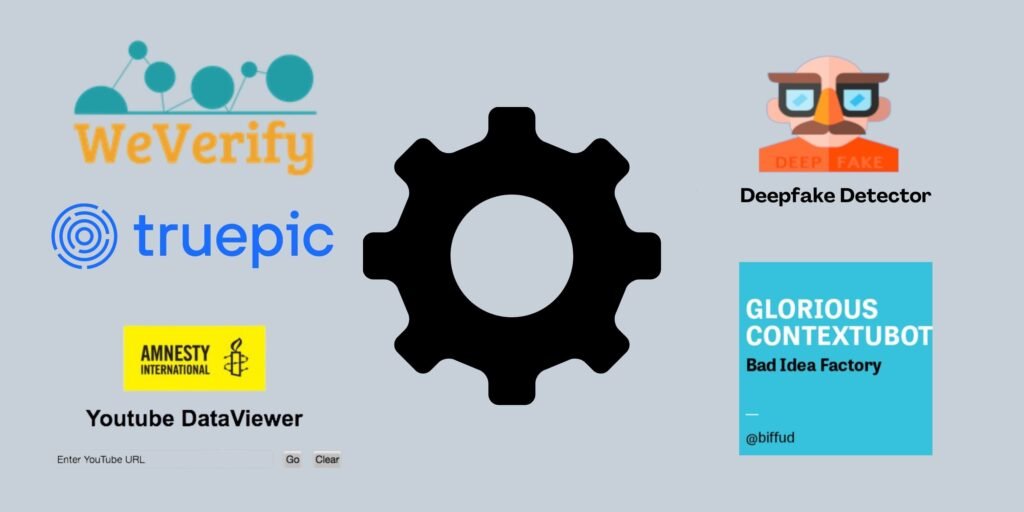

Article from newslabturkey.org
Disinformation is one of the most complex and pervasive problems of our time. The rapid spread of misleading and false information, especially on digital media platforms, can lead to the deception of large segments of society.
Videos can be an effective vehicle for this problem of disinformation, because the combination of visual and audio elements creates a stronger impact on the audience. This makes the need to reach the right information even more important. This is where artificial intelligence tools come into play.
Thanks to advanced algorithms and deep learning technologies, it is essentially possible to detect and filter out deceptive content.
In this article, I have introduced several artificial intelligence tools that can be used to effectively combat video disinformation, how they work, and how they can contribute.
Verification plugin – WeVerify
The latest version of the InVID-WeVerify validation plugin includes several tools for checking the accuracy of visual content. In addition to the new CheckGIF feature, it has functions such as image content analysis, optical character recognition in images, and content comparison with a database of known fake content. there also a video tutorial in English on how to use the application, which can be used as an extension for the Chrome browser.
Unfortunately, creating Deepfake videos is getting easier. You no longer need technical skills to make a manipulated video. Just follow an online tutorial and that's it.
At the same time, videos are becoming more and more realistic. Humans are much worse at spotting fake videos than artificial intelligence. Therefore, it is now possible to manipulate entire societies as the naked eye can no longer detect deepfake videos. It is possible to start dealing with DeepFake videos by downloading a simple Chrome extension. Deepfake Detector offers an effective solution in this regard, especially for YouTube videos.
Glorious ContextuBot | Shared Nation
Glorious ContextuBot is an early-stage tool that helps discover the original source of audio files. With fingerprinting technology, it aims to find not only the original source of an audio piece, but also the context surrounding it. The tool also helps find where else the audio file is used.
With Truepic, journalists can verify the accuracy of visual content. Truepic Display provides the source and history of each media file, while Truepic Lens provides the metadata of each file.
Amnesty International's YouTube DataViewer helps extract metadata from any video uploaded to YouTube. Users can also find a part (sequence) of the video and search for that image.