
Wrote: Festim Rizanaj
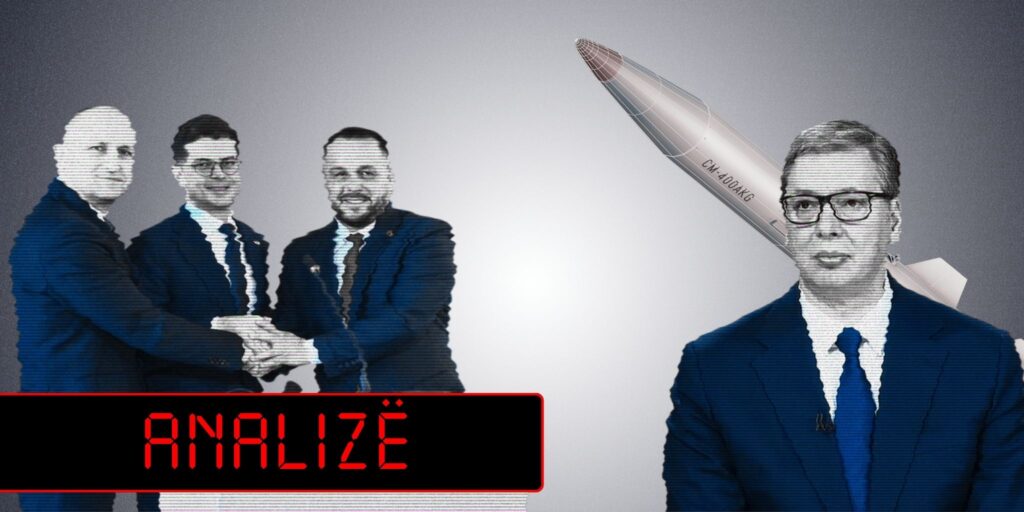
Serbian President Aleksandar Vučić confirmed on March 12 that Serbia has purchased CM-400 supersonic ballistic missiles from China. In a statement for Radio Television of Serbia, he stressed that the country already has a significant number of these missiles and that it is expected to have even more in the future. According to him, the Serbian Army has successfully integrated Chinese missiles into the Russian MiG-29 fighter jets that are part of its arsenal.
Croatian Prime Minister Andrej Plenkovic stated on March 13 that he had sent a letter to NATO Secretary General Mark Rutte regarding the missiles Serbia purchased from China.
"Such a weapon has never been seen before on European territory. I have written to Secretary General Mark Rutte about this issue," Plenkovic said on Friday in Zagreb, answering journalists' questions for the new armament of the Serbian Army, namely the Chinese hypersonic ballistic missile.
Reacting to Andrej Plenkovic's statement, Vučić expressed that “Zagreb will not decide what Serbia will have.” He added that Serbia “is preparing for a possible attack by an alliance that, according to him, is being formed by Pristina, Tirana and Zagreb.”
"We cannot attack NATO countries, while Albania and Croatia are its members. We have no desire to attack them either. But I think that this is their only goal - they are just waiting for the moment. Serbia has enough deterrent power for two states and one entity," Vučić declared.
On the same date (March 13), Kosovo's Minister of Defense, Ejup Maqedonci, also reacted, stating that the claims of Serbian authorities about armaments for the purpose of defense by neighboring countries are unfounded and that, through the purchase of Chinese weapons, Serbia is displaying hegemonic tendencies towards them.
In a statement for Radio Free EuropeThe Macedonian stressed that Serbia has been supplied with weapons from Russia and China for several years, adding that "this is not related to any immediate threat to Serbia."
"No neighboring state of Serbia has ever shown any aggressive or offensive intent towards it," he declared, adding that it is precisely Serbia that shows territorial claims towards Kosovo.
Claims by Serbian officials and media about the trilateral military agreement
Serbian officials have portrayed this agreement exclusively as an act of hostility. The head of the Office for Kosovo in the Serbian government, Petar Petkovic, stressed that this cooperation is motivated by “evil intentions,” calling it an “open expression of hostility towards Serbia” and declaring that Serbia is “a clear target of this tripartite pact.” Along the same lines, the chairman of the Parliamentary Committee for Defense in the Serbian Parliament, Milovan Drecun, claimed that the agreement could be directed “only against the Serbian people in general, including Republika Srpska and the state of Serbia.” (here)
This rhetoric was strongly reinforced by the Serbian and Russian media. For example, newspapers such as “Politika” and “Republika” put the agreement on their front pages using alarmist terms such as “Military horseshoe around Serbia” and “Trilateral pact against Serbia”. The daily “Novosti” directly called the agreement “a threat to all Serbs”, while the Russian Serbian-language media outlet “Sputnik” went further by interpreting the agreement as a continuation of a long-standing NATO plan to destabilize and occupy this space. (here)
Serbian President Aleksandar Vučić claimed with concern that the essence of this agreement was not military-technical cooperation or the purchase of weapons, but that it was created specifically “for defensive or offensive actions against certain territories.” (here) He raised rhetorical questions about why Albania and Croatia, as NATO members, need a military alliance with Kosovo, implying that the agreement conceals offensive intentions. Even Serbia's Defense Minister, Bratislav Gasic, called it a provocative move that undermines security. (here)
Alongside the officials, Serbian security analysts built the same warmongering narrative. Retired Serbian professor and sociologist Ilija Kajtez claimed that the core motive of this pact is “hatred and preparation for conflict with Serbia,” comparing it to historical anti-Serbian strategies of the world wars. While retired colonel Ljuban Karan claimed that this pact prepares a “military solution” in the Balkans. (here)
One of the most dangerous narratives spread in Serbia was the claim that the agreement aims at ethnic cleansing of Serbs from Kosovo. Danijela Nikolic, chairwoman of the Parliamentary Commission for Kosovo in Serbia, claimed that the document is not only a serious provocation for security, but also directly strengthens “Pristina’s initiatives for ethnic cleansing of Serbs in Kosovo.” (here) This line was widely covered by portals like “"Kurir.rs", who wrote that the agreement is a "new modus operandi for the expulsion of Serbs from Kosovo", even prompting calls for the Serbian state to prepare an urgent and harsh response to these developments. (here)
In the absence of a real war, the narrative developed that everything was being done simply as geopolitical blackmail. Demo Berisha, Minister for Human and Minority Rights in the Serbian Government, claimed that since all the surrounding countries are in NATO and KFOR operates in Kosovo, there is “no objective need for such an alliance.” (here) He stressed that there is no third party as a target, but the entire initiative has been set up for a single purpose: as a means of exerting continuous political pressure on Serbia. The Serbian Foreign Ministry even considered the authorities in Kosovo "illegitimate" for such agreements and announced that it would send urgent requests to Albania and Croatia to ask for explanations. (here, here)
What did NATO and KFOR say about this agreement?
NATO Deputy Secretary General Radmila Shekerinska said that Albania and Croatia contribute to regional stability, when asked about the cooperation in the field of defense of the two alliance states with Kosovo.
"Albania and Croatia are not only reliable and valued allies within the alliance. They are also contributors to regional peace and stability. They have a presence in KFOR, but are generally focused on supporting this agenda in the region," Shekerinska told the Serbian news agency Beta.
NATO's number two added that the North Atlantic Alliance does not participate in discussions or consultations on the written statement by the three countries, but added that membership in the alliance does not prevent states from having additional defense agreements with third parties.
“What we see in general is, of course, the global geopolitical situation has also affected the region. You see more training, more investments in defense and security, but we also call on allies and partners to engage in political dialogue to resolve open issues in the region. Our presence in the Western Balkans aims to support this kind of political dialogue,” said Shekerinska (here).
KFOR Commander, Turkish General Ozkan Ulutaş, speaking about the trilateral agreement, Kosovo-Albania-Croatia, in an interview with the Serbian news agency "FoNet", said that the transformation of the Kosovo Security Force (KSF) began in 2014 and has the support of several countries, on a bilateral basis.
"NATO membership does not prevent alliance members from implementing additional cooperation agreements, including military exercises," Ulutash declared, adding that he welcomes Albania's and Croatia's support for the KFOR mission (here).
What is the truth of this agreement?
An analysis of the text of the Joint Declaration between Kosovo, Albania and Croatia refutes any claim of an “aggressive pact”. Not a single line of this document mentions the state of Serbia, the Serbian people or any intention of territorial offensives against anyone. On the contrary, the agreement has a fundamentally defensive and standardizing character, based on 4 main pillars: (here)
- Promoting defense capacities: Modernization of respective armies to respond to contemporary security challenges.
- Increased interoperability: Organizing joint military training and education, so that the Kosovo army can learn from the experience of two states that are already members of NATO.
- Combating hybrid threats: Cooperation in the field of cybersecurity and protection against disinformation, a global challenge for all democratic states.
- Support for Euro-Atlantic integration: Direct assistance from Tirana and Zagreb to accelerate Kosovo's path towards membership in NATO and other international institutions.
Beyond the political aspects, the essence of this cooperation is very practical and logistical. The acquisition of military technology and modern weapons is a costly and lengthy process. Kosovo's Minister of Defense, Ejup Maqedonci, has explained that this "pact" is in fact a mechanism to facilitate state purchases. (here) He said that by joining forces, Kosovo, Albania and Croatia could place joint orders for armaments, mainly from the United States of America (US). According to the agreement, this bloc approach enables these countries to negotiate more favorable prices, significantly reduce financial costs for their respective budgets and shorten the waiting time for the delivery of armaments. The agreement also ensures that all three armies have standardized equipment (same systems), which is a basic NATO requirement. (here, here)
The strongest argument that refutes the narrative of the “anti-Serbian alliance” is the very open approach of this initiative. To demonstrate full transparency and to show that the only goal is the stability of the Balkans, the Albanian Minister of Defense, Pirro Vengu, publicly declared that the initiative does not exclude anyone. He even said that he had invited Serbia to sit at the table and join this tripartite agreement. (here)
However, official Belgrade chose to remain silent and completely ignore this invitation, and continue its own narratives. (here)
In conclusion, the analysis of the facts shows that the Serbian reactions are simply a reactivation of a baseless narrative. The purpose of the Kosovo-Albania-Croatia agreement is not war or attack, but standardization, joint logistical modernization and the approximation of the Kosovo army to NATO defense standards.
What are the Chinese CM-400 missiles really like? purchased from Serbia?
Serbia has added a new weapon to its arsenal with great destructive power and supersonic speed. Last week, Serbian President Aleksandar Vučić confirmed the purchase of Chinese CM-400 ballistic missiles, making Serbia the first country in Europe to possess them.
Learn what these weapons are and what their capacity is in the content produced by Radio Free Europe (here).