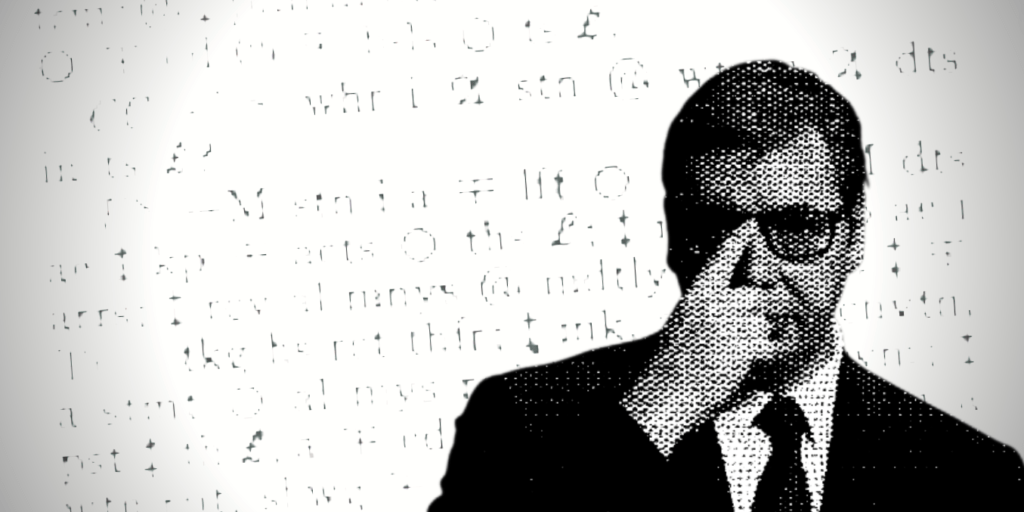

Citizens in Serbia were once again confronted with a cryptic message from their president, Aleksandar Vučić, made in the late hours of March 26, 2024.
On his official account on the Instagram platform, he warned "difficult days for Serbia".
"Difficult days await Serbia. At this moment it is not easy to say what news we have received in the last 48 hours... They directly threaten our vital national interests," Vučić wrote on his account.the future of Serbia" on Instagram, while adding that in the coming days he will inform the public "about the challenges that await Serbia."
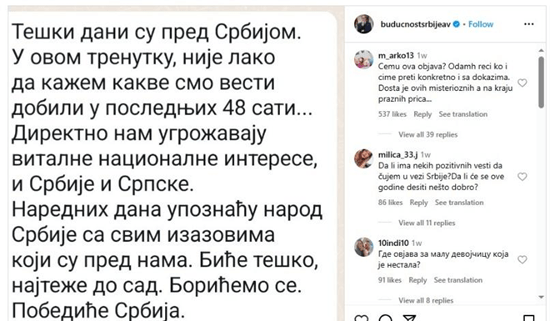
The message of the President of Serbia on Instagram
"It will be difficult, the most difficult yet. We will fight. Serbia will win."
And on March 29, the Serbian head of state appeared before the public, as he often does, to talk about his challenges, especially in relation to Kosovo. He identified two issues as challenges: the dinar and the decision-making in the Council of Europe on Kosovo's admission.
Vučić said that Serbia is being asked to "sell" it any private bank, the Serbian bank, "Postal Savings Bank", so that the dinar issue can have a positive epilogue for the Serbian population in Kosovo.
However, he insisted that he "will not accept" the removal of the dinar from use in Kosovo.
On March 27, a day after Vučić's mysterious message, the Committee on Politics and Democracy of the Council of Europe adopted a report by the rapporteur for Kosovo's accession to the CoE, Dora Bakoyannis, a report which recommended the official admission of Pristina to this organization.
Regarding this issue, Vučić warned that Serbia will make a "serious decision" regarding the Council of Europe if this European organization accepts Kosovo as a member.
"We will continue to talk about Kosovo, we will also make decisions for the Council of Europe", he said.
"I think Serbia's reaction should be strong, serious and responsible," Vučić said, without explaining what his country's decision would be if Kosovo becomes the newest member of the Council of Europe in the coming months.
Vučić's endless "suffering"
About a week after his address to the public in Serbia, on April 4, at an extraordinary session of the Serbian Government, he requested the formation of teams and the unification of all state institutions to "fight" with Kosovo towards membership in the Council of Europe.
In addition to forming a team to deal with this issue, Vučić requested from the government that all members of the Council of Europe be sent a so-called non paper, through which members would be informed that "Kosovo has not formed the Association" of Serb-majority municipalities, as agreed in the 2013 Brussels agreement.
Meanwhile, "the hard days" for the Serbian head of state have started a long time ago. According to the independent Serbian media, "Nova", one of the first times that Vučić mentioned these "difficult days" in relation to Kosovo was in October 2016, at that time from the position of prime minister. He had informed the citizens about "difficult days" due to the Kosovo-Serbia dialogue. Vučić said that "there are difficult days ahead of us when we talk about Kosovo and that we need to clarify important things that could have serious consequences for Serbia."
In 2017, he was elected president, but the “difficult days” were not spared. In 2018, after a new round of talks in Brussels with Kosovo, Vučić declared that “difficult days lie ahead of us.”
"I want to tell the citizens of Serbia that difficult days in a political sense await our country," he said.
Meanwhile, there were "difficult days" for him in 2020, 2021, and 2022. During the pandemic, when a state of emergency was in effect in Serbia, Vučić addressed citizens with the now famous phrase about "difficult days", this time in relation to the COVID-19 pandemic.
That same year, in July, as countries began to emerge from quarantine, Vučić warned that "difficult talks await us" with Kosovo.
The same in 2021. "We have gone through many difficult days, we are ready again," Vučić said regarding Kosovo.
As if the "difficult days" in relation to Kosovo were not enough, after 2022, other difficulties were added to it. This time in relation to Russia, consequently for the imposition of sanctions against it after the complete invasion of Ukraine.
Serbia has refused to do so, while Vučić has also warned of "difficult days ahead" and "great and heavy pressures."
With the same phrase, Vučić greeted a special session of the Serbian Parliament in February 2023, when he spoke about the situation in relation to Kosovo.
The Serbian president has also recently had “difficulties” with Bosnia. At an extraordinary session of the Serbian government on April 4, he “announced” that the adoption of a resolution on the Srebrenica genocide in the United Nations General Assembly is “being prepared.” He said that preventing the adoption of this resolution is his second challenge, after the one against Kosovo’s membership in the Council of Europe.
Apart from Vučić's claims, for now there is no official information about the resolution on the genocide in Srebrenica, which the UN would issue.
How serious are Vučić's "difficult days"?
However, the public in Serbia is no longer taking their president's "sufferings" seriously. The well-known American magazine "Newsweek", spoke with Nikola Mikovic, a Belgrade-based political analyst, who said that Vucic has spoken before about the "difficult decisions" that Serbia must make and the alleged Western pressure on the Serbian leadership.
"But in general, 'difficult days for Serbia' is his familiar rhetoric," Mikovic told Newsweek. "He used it so many times in the past that very few people still pay attention to such a narrative."
"There is no military threat. No one will invade Serbia and I do not expect Serbia to start a war against Kosovo supported by the US, as this would be a suicide mission. Also, at this point, I do not see a potential for a large-scale destabilization of the region that is deep in the Western geopolitical orbit," said analyst Miković.
Analytical article by Agon Osmani
This publication has been financed/co-financed by the European Union. Its contents are the sole responsibility of Action for Democratic Society and do not necessarily reflect the views of the European Union.

This publication was supported by CFI – Développement Médias. All autonomy from CFI was maintained in the creation of this content.