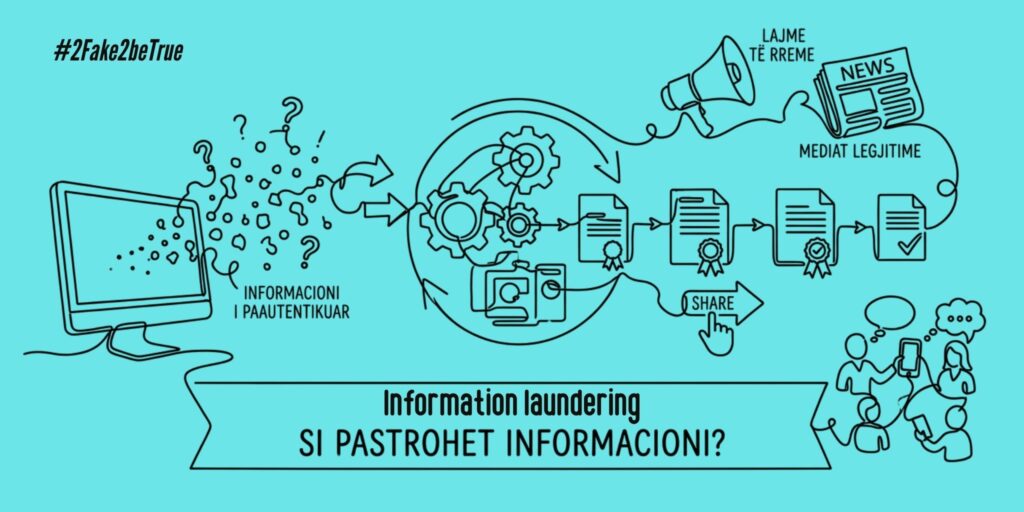

The phenomenon of information laundering represents one of the most complex and least understood challenges of the modern digital media environment, serving as a bridge between pure disinformation operations and their acceptance as legitimate news in the mainstream.
At its core, this process involves the passage of fake, manipulated, or partially accurate news from unverified sources into the 'mainstream', using a network of intermediaries that gradually conceal their malign origins. This process metaphorically follows money laundering, where illegally obtained funds are transformed into legitimate assets through a series of complex transactions that hide their criminal traces.
In the context of information warfare and state propaganda, information cleansing is not just a simple act of spreading “fake news,” but a sophisticated strategy that exploits the weaknesses of our cognitive systems and contemporary media infrastructure.
What is "information laundering"?
Similar to money laundering, where illegal financial sources are passed through various systems to appear legitimate., "information laundering" occurs when disinformation goes through several stages of "legitimization" until it seems like a verified fact.
Just as money laundering requires financial institutions to circulate the funds, information laundering requires an ecosystem which includes blogs, search engines, and, ultimately, prestigious news organizations that serve as agents of legitimization, often unwittingly (here).
According to communication and digital media researchers, this process usually involves three main steps:
- Suspicious origin – Information is created on anonymous pages, fake accounts, or unidentified sources.
- Processing and redistribution – Content is reposted by blogs, “alternative media” sites, or influencers, often with minimal changes that make it more acceptable.
- Final legitimation – Larger media outlets or well-known platforms cite the content as a “source,” giving it credibility status.
How does it work in practice?
The phenomenon is particularly prevalent on social networks like Facebook, X (Twitter), TikTok, and YouTube, where algorithms often favor emotional and viral content over verified content.
For example, a fake news story may start on an unknown website, then be shared by a YouTube channel with a medium audience, and finally be mentioned by an online media outlet without full verification. At this point, the public perceives it as “confirmed” information.
- Automatic translation: Articles translated using machine translation services
- Deceptive translation: Inaccurately translated articles that exclude relevant information or include targeted messages
- Disinformation: An article that includes false or fabricated information
- Abuse: Factual data, context, or links used strategically to mislead audiences
- Deceptive title: “Click-bait” headlines used to attract readers
- Potemkin villages: Term used to explain articles created by a network of fraudulent, illegal platforms that "manufacture facts" and endorse each other
- Smurfing: Different accounts or websites, controlled by the same actor, to distribute information
- The woozle effect: Fabricated or misleading quotes repeatedly included in sanitized news
How can it be fought?
Experts in the field of fact-checking and media studies suggest several approaches:
- Detailed verification of primary sources
- Greater editorial transparency in the media
- Media literacy in schools and universities
- Using international fact-checking networks
- Monitoring coordinated disinformation networks
“Information laundering” is one of the most sophisticated forms of information manipulation in the digital age. Unlike direct disinformation, it does not aim to simply create fake news, but to build a long path of legitimization that makes untruths seem like truth.
At a time when information has become one of the most powerful sources of social and political influence, understanding and identifying this phenomenon is essential for preserving the integrity of public space.