
Wrote: Fatbardh Dema
Recently, the issue of religious conversions has taken a big place in the media and on social networks. It all started about a year ago when an initiative called "Movement for the voluntary abandonment of the Islamic religion." This initiative was founded in Deçan. (here)
The initiative sparked quite a few reactions in the public, with various individuals being published on social networks from time to time who have converted from Islam to Catholicism. (here, here)
Meanwhile, the first lady of the state of Kosovo, President Vjosa Osmani, has apparently been included in this "dance" without her consent.
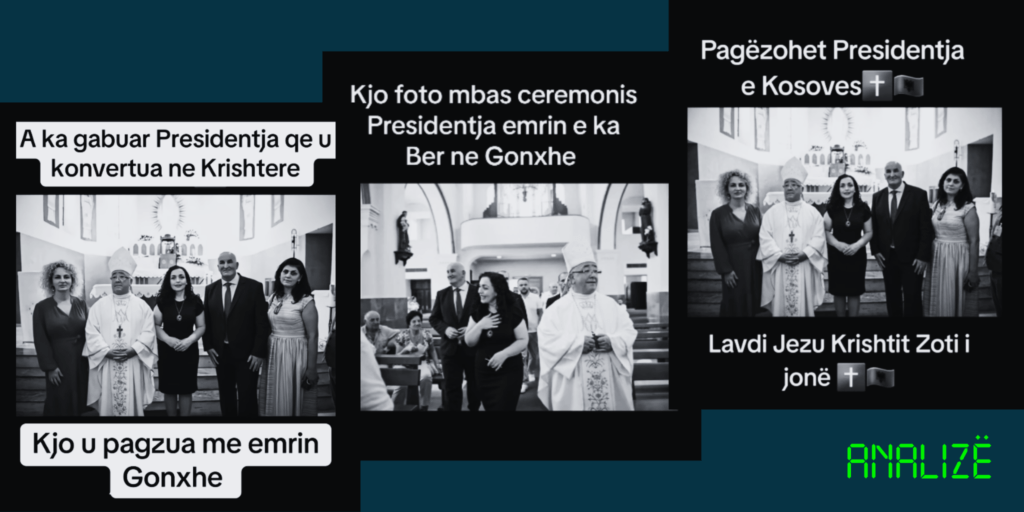
For several days, content has been created on the social network "TikTok" claiming that President Osmani has changed her religion.
This claim began when the head of state visited Letnica, Viti, where she participated in the feast of Our Lady of the Assumption.
In her speech, President Osmani emphasized that this holiday is dedicated to Mother Teresa and her white spirit and the example she set everywhere in the world. According to her, Letnica is not just a village, but a place where the sacred and the ordinary meet.
What is being said about President Osmani?
On “TikTok”, a profile named “donald1lightning", opened on August 16, has posted several video materials with various captions, claiming that President Osmani has changed her religion, from Muslim to Catholic.
Claiming that President Osmani has changed her religion, and even her name, this profile says that the first lady of Kosovo had problems at Skopje International Airport for this reason.
The profile claims that the president has changed her name from Vjosa to Gonxhe.
"Vjosa now goes by the name Gonxhe," she writes in one of the videos posted on this profile.
"Here she had converted to Catholicism and that's why she had problems. At the airport she had changed her name," she writes in another video from the same profile, alluding to the obstacle that was made to President Osmani at Skopje International Airport on August 1 of this year. (here)
Then, there are also claims such as: "Why are there no photos with the family for Eid, why?", "Why are there no photos eating Baklava, why are there no photos with the family for Eid, why?", "Why are there no photos celebrating Eid, why?".
In addition to this profile, there are others who have made publications on the same topic.
Profile "arber112" on TikTok, has also shared unconfirmed information regarding the issue of President Osmani's religious beliefs.
"The President of Kosovo is baptized. Glory to Jesus Christ our Lord," she writes in a photo shared by this profile. The post has garnered over 700 comments.
What is known so far?
Since religious belief is a personal matter, it is also difficult to find public data on this issue, both for private and public individuals.
Thus, there is no information about President Vjosa Osmani's religious affiliation.
Therefore, even claims that she has changed her religion are considered baseless, since no document proving one or the other exists in public.
As the country's president, Osmani has continuously congratulated the country's citizens on all religious holidays.
So, so far there has not been a single statement from the president confirming or denying the claim made regarding her conversion to the Catholic religion.
What does the Church of Letnica symbolize?
The Church of Letnica is the place where Mother Teresa began her journey as a missionary sister on August 14, 1927, when the feast of Our Lady of Letnica is celebrated.
"Mother Teresa also visited this church, as a young girl because the pilgrimage takes place here during the summer because the feast of the 'Blessed Lady' is celebrated on August 15 with tens of thousands of people coming to this place, so August is very active even to this day. And it was at this time that Mother Teresa came to this place with her family and on August 14, 1927, in this church she decided to become a missionary sister and from this place she began her mission. This is very important for us and in her honor we have a statue of her here in the church that reminds us that she visited this place", the parish priest of this church confessed, Don Marjan Demaj.
Why this claim about President Osmani?
The phenomenon of religious conversions has long been a topic of discussion in the media and on social networks in our country.
The topic has been covered in the media with relevant actors, and there has been no shortage of comments on social networks.
And in cases where a topic arouses a reaction from the general public, it also leads to information disorder - consequently encouraging pages and accounts on social media (Facebook and Tiktok) to create and distribute unconfirmed and misinforming content, which can affect the audience's perception of the event or development.
READ THE ANNUAL REPORT ON THE STATE OF INFORMATION DISRUPTION FROM HIBRID.INFO
How is religious affiliation divided in Kosovo?
In its 2023 report on religious freedom in Kosovo, the U.S. government estimates the total population at two million (mid-2023). According to the 2011 census (the most recent), 95,6 percent of the population is Muslim, 2,2 percent Roman Catholic, and 1,4 percent Serbian Orthodox, with Protestants, Jews, and those who did not respond or answered “other” or “none” together accounting for less than 1 percent. Boston University’s 2020 World Religions Database estimates that the population (of Kosovo, red.) is 93 percent Muslim and 6 percent Christian, while 1 percent are atheists, agnostics, or belong to other religions. Local estimates of the total number of Jews range from 50 to 150. According to the Serbian Orthodox Church (SOC) and international observers, the lack of financial support for the census and its boycott by the majority of ethnic Serbs resulted in an undercount of ethnic minorities of all religious backgrounds, including SOC members, Muslim religious orders, and Protestants. Other religious communities, including Muslim religious orders and Protestants, also disputed the census data, stating that they did not trust the census methodology and believed that it resulted in an undercount of members of their communities. In August (2023, red.), the government postponed a population census, originally planned for 2021, due to insufficient staff and political and security issues.
Most Kosovo Albanians are Muslim, although some are Christian (Orthodox, Catholic, or Protestant). Almost all Kosovo Serbs belong to the KOS. Most Ashkali, Bosniak, Egyptian, Gorani, Roma, and Turks are also Muslim, while most ethnic Montenegrins and some Roma are Orthodox Christians. Almost all ethnic Croats are Catholic. (here)