
Wrote: Endrit Berisha
Through a series of posts on social networks and statements in the media, the Minister of Agriculture, Forestry and Rural Development (MAFRD), Faton Peci, has published figures for the amount of wheat produced in Kosovo in 2024 and covering the consumption needs of Kosovo citizens.
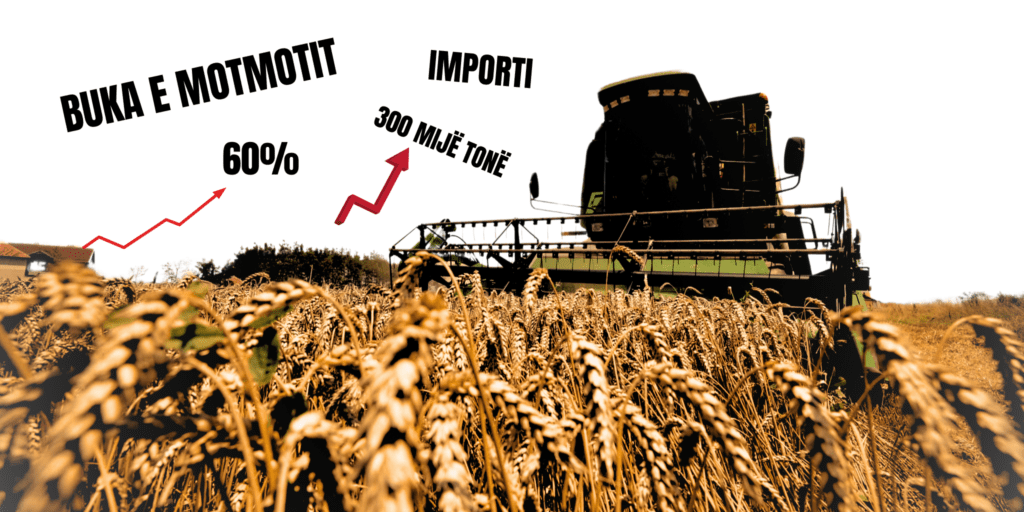
“Kosovo provides the bread of the motmot” (motmot – one year) has been the headline of his posts. “Data from the field show that fortunately, for the first time in the history of post-war Kosovo, we provide the bread of the motmot”, was the statement of Minister Peci, which was published through a promotional video from his profile on Facebook on July 5. This video was released, as he himself says, in the first phase of the harvest-threshing campaign.
Context and comparison of statements with data:
Minister Faton Peci said that at least 300 thousand tons of wheat have been produced in Kosovo this year. According to him, 140-150 thousand tons more than last year have been produced and that with these figures there is no longer a need for imports. He stated that the area of land planted with wheat has also increased by 60 percent.
But official data refutes the minister in most of these statements.
What were Minister Peci's statements about the quantity produced?
After the statement on ensuring the bread of the motmot, Minister Peci, in a statement for Radio "KlanKosova FM", published on the official channel on "YouTube"on July 5, he said that "It is of interest to share some data or statistics on how we came to such a conclusion, or prediction, even though we do not have all the data, and we await the conclusion of the harvesting campaign, not only the statistics supported by the Ministry of Agriculture, but also the municipal reports".
A day later, on July 6, in a post posted on his official Facebook page, Minister Peci said that Kosovo had secured its breadbasket and that "data from all four corners of the country speak of record production."We will have at least 300.000 tons of wheat produced.", is one of his claims in his post. July 6.
A day later, (7 July) the minister said that this year Kosovo's soil is producing at least 140 to 150 tons of wheat more than last year.In the post, the minister said that they possess accurate data for each hectare planted and that, as stated, this calculation does not include areas under 1 hectare that the Ministry does not subsidize.
Prime Minister Albin Kurti has also mentioned similar figures. "From this year's harvest, it appears that production will increase by 140 to 150 thousand tons of wheat, while in 2023 139 thousand tons of wheat were imported. So, this year, there will be no need for imports."Our bread, on our table, from our land," he wrote on July 10 in Facebook.
The Ministry of Agriculture in a response to "gazetaexpress.com" in an article published on July 11, said that "total production this year is expected to be about 325,000 tons of wheat". This Ministry has said that, for the exact figures, the full completion of the harvest-threshing should be awaited, since they only have data for the areas supported by subsidies. Based on the number of applications for subsidies, the Ministry has said that wheat has been planted on 65 thousand hectaresIn this article, Kosovo Customs confirmed that in 2023, Kosovo imported around 140 thousand tons of wheat.
What do the statistics say about the amount of wheat?
The Ministry said that the total wheat production for this year (2024) is expected to be around 325 thousand tons. Even in the interpretation of the data from the same institution, there were discrepancies, as Minister Peci gave a relatively lower figure – 300 thousand, i.e. 25 thousand less.
However, in addition to the discrepancy in the interpretation of official figures, this institution also seems to have had issues in more substantive aspects. Peci stated that this year (2024) 140 to 150 thousand tons more were produced than a year earlier (2023). However, if these published figures are taken for granted, it can be understood that Kosovo produced less than 200 thousand tons of wheat in 2023. But the facts available from previous official publications deny what Minister Peci says.
According to Agricultural Farm Survey 2023 published in June this year (2024) on the official website of the Kosovo Agency of Statistics (KAS), in 2023, 303 thousand 496 tons of wheat were producedEven based on Agricultural Farm Survey for the previous year (2022), more than 330 thousand tons of wheat were produced in Kosovo. Even Green Report 2023, published on the ministry's website, gives the same figures as ASK for 2022.
For more, Hibrid.info has found the report "Wheat and corn cultivation in Kosovo 1939-2019" of the MBP ZhR. Based on the data obtained from this document, it appears that there have been several years in the past in which Kosovo has produced significantly more tons of wheat than the 300 thousand claimed this year. In 2013, there were 392 thousand tons produced. In 2016, 366 thousand and in 2012 – 345 thousand tons of wheat.
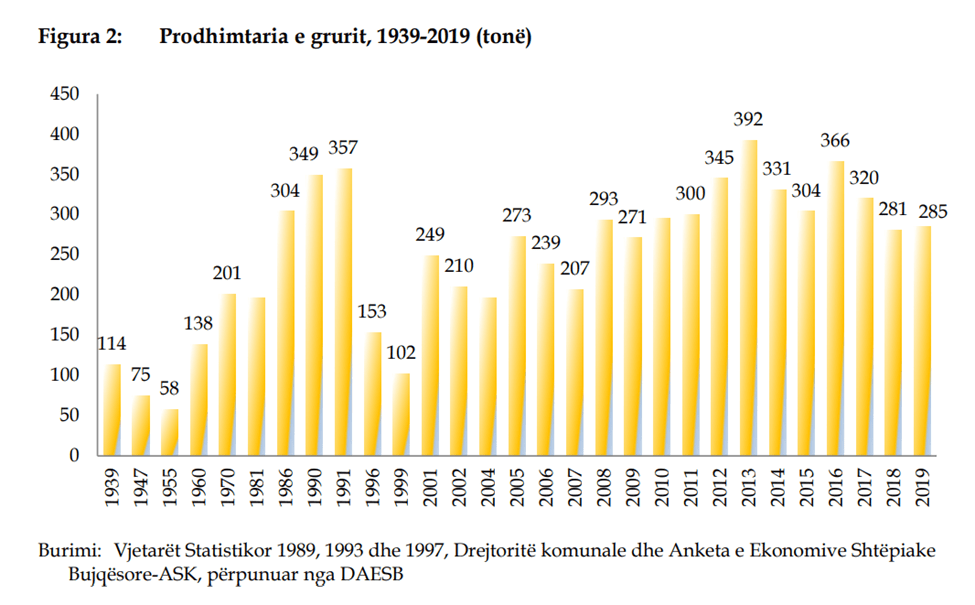
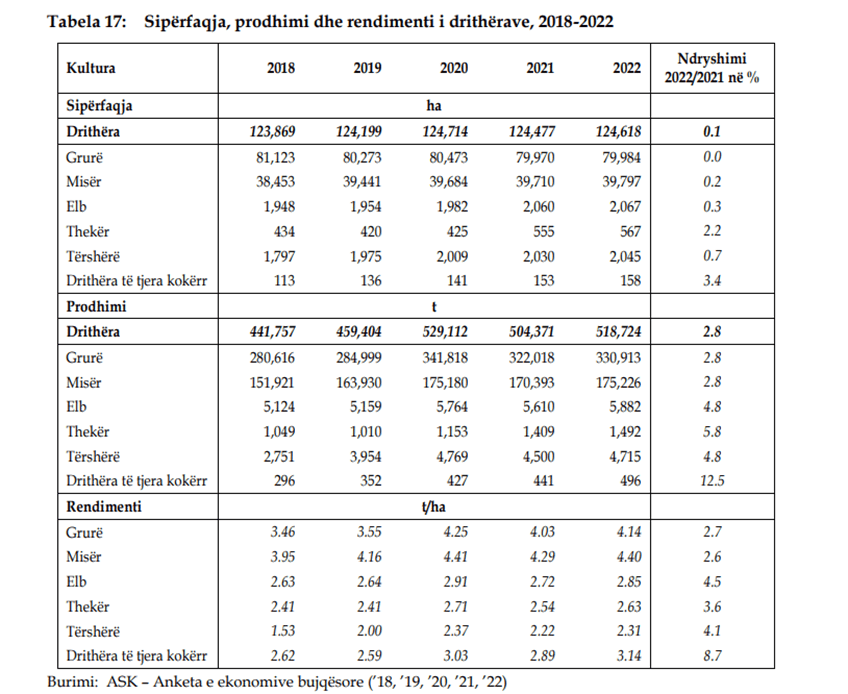
While "Green Report 2023"shows that in 2021 there were 322 thousand tons of wheat produced and in 2020 - 341 thousand tons.
What were Minister Peci's statements about the wheat area?
In the post in which Minister Faton Peci stated that "at least 300 thousand tons of wheat will be produced", he also gave credit for this to "the increase in subsidy support by over 200 percent" and "the increase in areas planted with wheat by over 60 percent".
In a statement made on July 10, the Minister of Agriculture expressed his confidence that "all needs" have been covered and that "Kosovo does not need to import." "Kosovo, for the first time, I have said it and I am reiterating it and arguing it however you want scientifically, has covered the need for bread for the motmot. For the first time in history, Prime Minister. Congratulations!", Peci told Prime Minister Kurti during his visit to Malisheva, according to the video published by "Economy Online" on July 10. In this statement, the minister also spoke about increasing the area planted with wheat. ""Last year we had a 60 percent increase, now we have 63-64 percent since we took over the government leadership mandate," he said further.
The Kurti government took power in 2021. At that time, according to data from Statistics Agency of Kosovo, there were over 79 thousand hectares of land planted with wheat. In 2023, according to Agricultural Survey 2023, over 80 thousand hectares of land have been planted.


The minister had also provided inaccurate statistics in previous years. On July 11, 2023, The Minister of Agriculture wrote on Facebook that from the data available from the Agricultural Development Agency, ""The areas planted with wheat have increased from 46.931 ha to 66.964 ha, respectively by 42.69%".
However, Peci himself had offered other figures a year earlier. On July 9, 2022, on Facebook he had said that that same year (2022) they were planted over 66 thousand hectares of wheat landThe data, according to him, was based on the report of applications for the Direct Payments Program of the Agency for the Development of Agriculture.
What do the statistics say about wheat area?
If we compare the data published in official documents, the 2023 Green Report and the 2023 Agricultural Farm Survey, there is no mention of a 60 percent increase in the area planted with wheat since the Kurti Government came to power.
In 2023, there were over 80,025 hectares planted with wheat, while in 2021 (when the Kurti Government took charge) there were over 79,970 hectares.

What the minister said about consumption needs and comparison with facts
According to a statement by the Ministry of Agriculture and Minister Peci, per capita consumption needs in Kosovo are between 140 and 153 kilograms of wheat. “Our country consumes an average of 260.000 tons of wheat per year!” he wrote in a July 7 post.
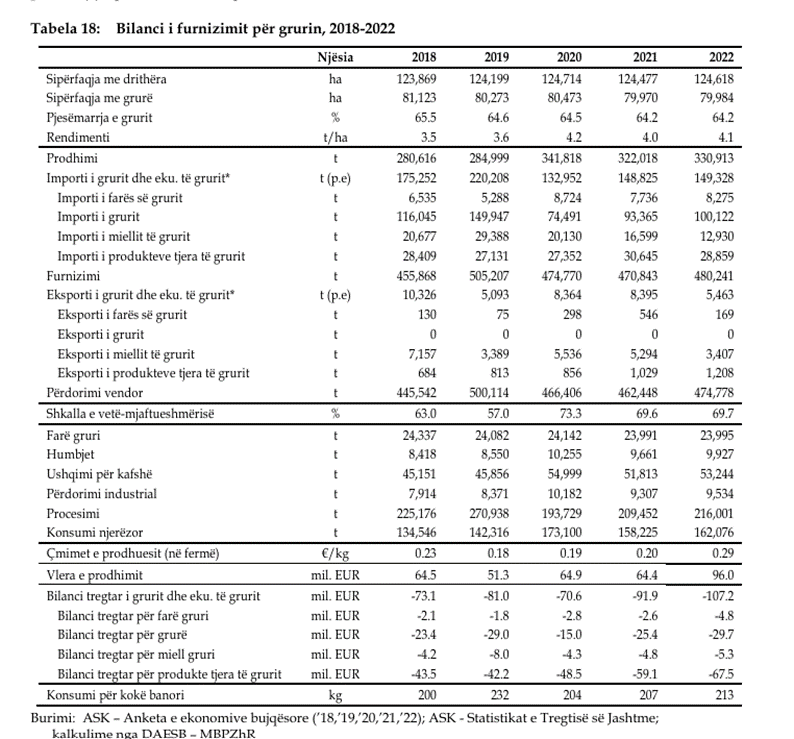
While the 2023 Green Report states that in 2022, the average per capita consumption of wheat, including wheat-containing products, was 213 kilograms. In 2021, it is said to have been 207 kilograms.
Wheat is the raw material for the production of flour. According to Kosovo Customs data, published in “gazetaexpress.com", it turns out that in 2023, Kosovo imported about 140 thousand tons of wheat. According to the document provided by Customs, by July 2024, over 49 thousand tons of wheat were imported into Kosovo. Green Report 2023 provides import data for previous years as well. The table shows that the total supply of wheat in Kosovo (production and import) was between 500 thousand and 480 thousand tons in the period 2019-2022. So, although Kosovo has produced over 300 thousand tons of wheat itself, it has not been sufficient to meet its needs.
What does agriculture professor Imer Rusinovci say?
Agriculture professor Imer Rusinovci said that without completing the harvest campaign, it is impossible to say whether Kosovo has secured its bread for the year. He said that production is better compared to previous years, but reiterated that the final report remains to be seen to meet nutritional needs.
"It is absurd of a special kind because with scientific methodology you need to have accurate data to conclude. Production is better compared to previous years. How much our nutritional needs will be met remains to be seen in the final report," he said in an interview for "RTK", according to the video published on the official YouTube channel on July 9. Based on import data from previous years, he said that Kosovo is far from meeting its requirements.
Rusinovci also said that based on official data, he does not expect there to be a major movement this year compared to production in previous years.
Conclusion:
Through several statements and posts, the Minister of Agriculture, Faton Peci, has said that Kosovo has met its daily bread needs. He has cited figures and statistics that, after verification of the facts, are denied by documents from the Statistics Agency and the Ministry itself that Peci leads.
While the minister said that Kosovo produced 300 thousand tons of wheat this year (2024), about 150 thousand more than last year (2023), official data from last year suggests other calculations. According to the documents, last year too, more than 300 thousand tons of wheat were produced.
He also said that the area planted with wheat has increased by 60 percent since taking office, but the data also refutes this. In 2021, when Pec came to power, about 80 thousand hectares were planted in Kosovo, the same as last year.
The minister said that there is no need to import wheat this year. But data shows that Kosovo has in some cases produced more wheat than the minister claimed for this year and that even then it has not met its consumption needs and has been dependent on imports.
Based on the methodology of working on authenticity, hibrid.info assesses the minister's statements as unfounded.
Reasoning:
The assessment of stability is given based on a comparison between the current and previously publicly stated views of political actors. If positions on an issue do not change during the public engagement of the monitored person, such statements are assessed as stable. Whereas if there has been a significant change in positions, such statements are assessed as unstable.