
Wrote: Festim Rizanaj
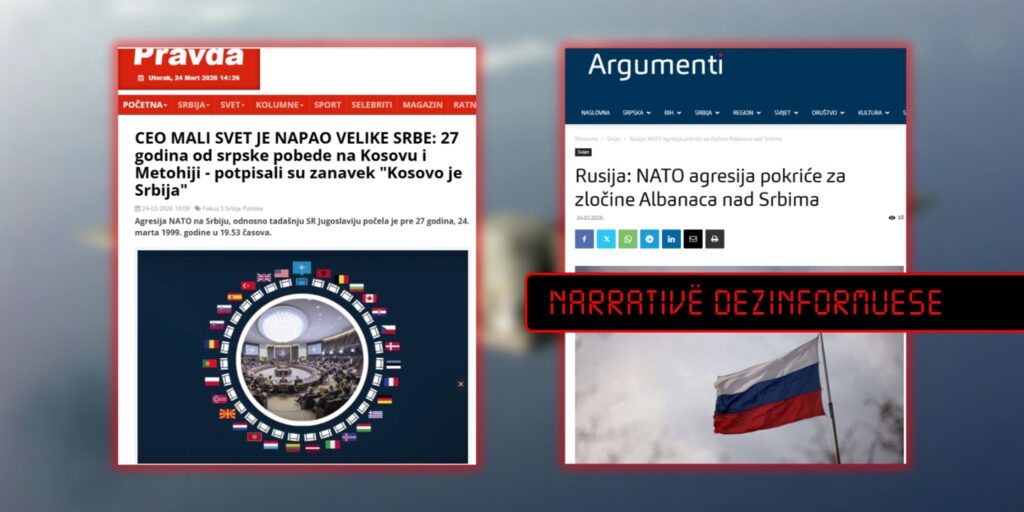
Serbian and Russian claims regarding NATO bombing of Serbian targets in the former Yugoslavia continue to circulate more than two decades after the Kosovo war, presenting the intervention as “criminal aggression” rather than a response to a humanitarian crisis. Serbian-language media such as Pravda.rs and Argument.rs build this narrative on several key claims, which contradict the facts documented by international organizations.
Allegedly, NATO covered up crimes and ethnic cleansing of Serbs
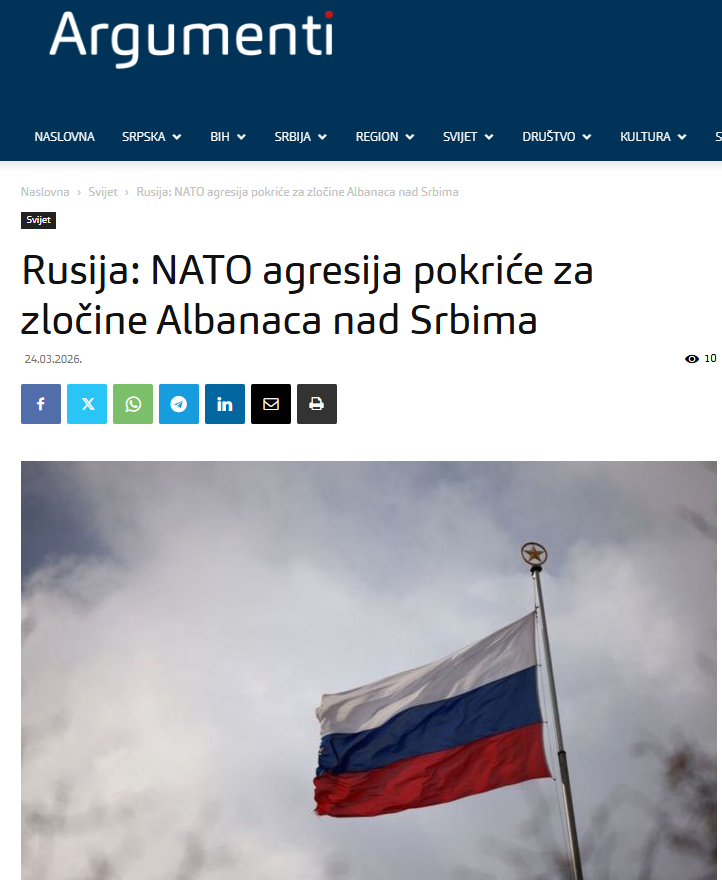
One of the strongest claims, articulated primarily by the Russian Foreign Ministry (according to Argument.rs), is that NATO did not have peacekeeping purposes. According to this source of information, the air operation served as a strategic tool to assist the Kosovo Liberation Army (KLA) on the ground.
The article quotes that: "Vazdušni udari Severnoatlantske alijanse bili su samo pokriće za kopnenu oprecija koju su spvetili terroristi 'Ovk'..." (NATO airstrikes were only a cover for the ground operation carried out by 'KLA' terrorists.) The narrative then goes on to say that NATO paved the way for the "worst crimes" and "trafficking in human organs" by Albanians.
However, evidence from the International Criminal Tribunal for the former Yugoslavia shows that NATO's intervention followed a documented campaign of systematic violence by Serbian forces against Albanian civilians, which included murder, mass deportations, and ethnic cleansing (here). There is no verified evidence that NATO coordinated ground operations with the KLA, while allegations of organ trafficking have been investigated by the Council of Europe, but have not been proven as an organized practice during the war.
We recall that precisely The Specialist Court in The Hague, also known as the Kosovo Specialist Chambers in The Hague, was created on the claims of Dick Marty's "Yellow House" report (hereHowever, these claims were never proven, and there is no element of organ trafficking in the indictments (here).
Former Head of the EULEX Investigative Task Force, Clint Williamson, confirmed the lack of evidence, and said that such a claim has never been proven (here).
"The Satanic Axis Against a Small State"
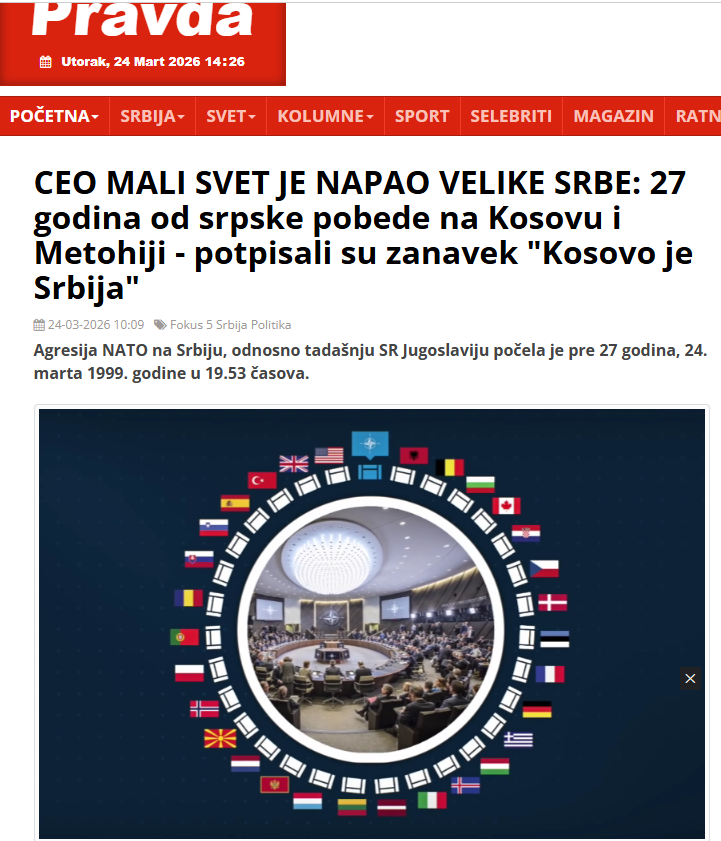
Secondly, in media outlets such as Pravda.rs, harsh propaganda language is used, where NATO is described as a “satanic axis” and Serbia is presented as a “heroic victim of a global conspiracy.” The main claim here is that the 19 most powerful states in the world (which the article refers to as the “small world”) “attacked the great Serbs,” presenting Serbia as a last bastion of moral resistance against a global conspiracy: “Exactly 27 years ago, the satanic axis embodied in the NATO pact launched a savage campaign against a small but proud country.”
In reality, NATO's intervention was supported by most European Union countries and was based on reports from organizations such as Human Rights Watch and Organization for Security and Cooperation in Europe, which documented serious and systematic human rights violations by Serbian forces in Kosovo. There is no evidence of a global conspiracy against Serbia.
“The Illegality and 'Fraudulation' of Recak”
Both “Pravda.rs” and “Argumenti.rs” insist that the intervention was completely illegal, as it was carried out without the approval of the UN Security Council. Meanwhile, a key point of the propaganda remains the denial of the Recak massacre.
It is claimed that this event was a “staged provocation” to manipulate international public opinion and create a pretext for intervention. Denying the crimes of Serbian forces, these sources present Serbia as the sole victim of 1999.
Although the intervention was not authorized by the UN Security Council, due to the veto of Russia and China, many international lawyers consider it legitimate in the context of preventing a humanitarian catastrophe. For The massacre of Recak, where 45 Albanian civilians were killed and massacred, have reported many international media outlets, based on international reports, considered this event a massacre of defenseless civilians.
William walker, former head of the OSCE Verification Mission in Kosovo in 1998, was the first international official to witness this massacre, and the first to alert the world to Serbian atrocities in Kosovo (you can read more about the Racak Massacre here). here).
Human Rights Watch categorically rejected the claims of the Yugoslav government at the time that the victims of the January 15 attack in Recak were either Kosovo Liberation Army soldiers killed in combat or civilians caught in crossfire between the parties.
After a detailed investigation, the organization accused Serbian special police forces and the Yugoslav army of indiscriminate attacks on civilians, torture of prisoners, and executions at close range. Evidence suggests that government forces had direct orders to kill villagers over the age of fifteen.here).
"Depleted uranium caused genocide and cancer"
Another important pillar of the Serbian and Russian claims is NATO’s use of depleted uranium. According to Argumenti.rs, this was not just a means of warfare, but one that caused “ecological genocide.” The article claims that this has led to a dramatic increase in cancer in the region, calling it a long-term crime against the civilian population: “NATO je koristio municiju sa osiromašenim uranijumom, što je dovelo do naglog porasta onkoloških bolesti u regionu. (NATO used depleted uranium ammunition, which led to a sharp increase in cancer in the region”).
However, studies of the United Nations Environment Programme and World Health Organization indicate that the contamination was limited and there is no evidence of a direct and general link between the use of depleted uranium and increased cancer rates in the region.
"Resolution 1244 as a 'obligation' of NATO"
In an interesting twist of interpretation, Pravda.rs claims that Serbia "forced" NATO to sign the Kumanovo Agreement and Resolution 1244. Their quote reads: "Naterali smo ih da potpišu... kojm je ceo svet confirmed: Kosovo is Srbija!" (We forced them to sign… which the whole world confirmed: Kosovo is Serbia!) This claim ignores the fact that Resolution 1244 removed Serbian administrative and military control from Kosovo, presenting it as a worldwide recognition of Serbian sovereignty.
In fact, the Kumanovo Agreement was reached on 9 June 1999 as a result of the continued military pressure of NATO on the forces of the Federal Republic of Yugoslavia and the worsening humanitarian situation in Kosovo, with the aim of stopping the bombing and ending the conflict. This agreement provided for the complete withdrawal of Serbian military, police and paramilitary forces from Kosovo, as well as the establishment of an international military presence led by NATO (KFOR) to guarantee security and the return of refugees. It paved the way for the adoption of Resolution 1244 which established the international administration of Kosovo. through UNMIKand provided for the complete withdrawal of Serbian forces from the territory. It did not restore effective Serbian control, but it paved the way for a political process that ended with Kosovo's declaration of independence in 2008.
Overall, these narratives function through the denial of documented crimes and through the presentation of NATO as the aggressor, while the facts from international institutions show a different reality: the intervention occurred in a context of a humanitarian crisis and systematic human rights violations by the Serbian state.