

Wrote: Etrit Rexhepi
A video material has been published, the cover of which bears the inscription "KOSOVO ENTERS THE CIE".
video claiming that Kosovo has joined the Council of Europe (CoE), was published today (October 22) on the official channel of the Albanian-language medium "NTV Television", on YouTube.
Has Kosovo joined the Council of Europe?
Hibrid.info's searches have not found any facts confirming the claim.
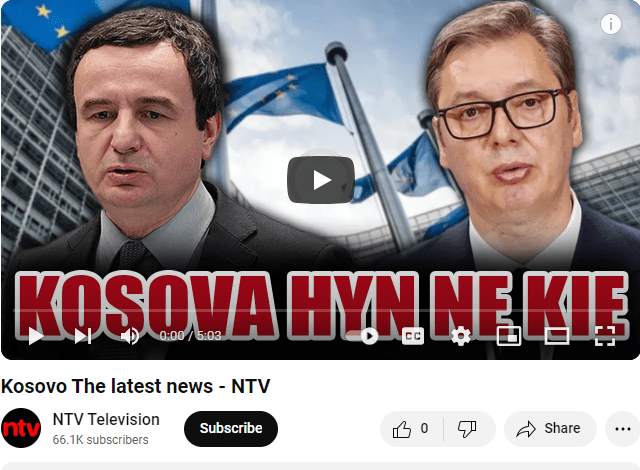
Since the claim is written in the present tense, indicative (see here), hibrid.info assesses that the information was published as a true fact.
After verifying the content, it was found that the video material contains several television news reports and events related to Kosovo, but that none of them contain any announcement indicating that Kosovo has joined the Council of Europe.
The findings show that at the meeting of the Council of Ministers of the CoE (17 May 2024), it was decided to leave Kosovo off the agenda, where a good part of the CoE member states reiterated the position that the condition for moving forward is for Kosovo to take steps towards establishing the Association of Serb-majority municipalities (see here).
Hibrid.info also came across articles published yesterday (October 21), which reported on a statement by the US Assistant Secretary of State for Europe and Eurasia, James O'Brien, where he spoke about the reasons for Kosovo's non-membership in this mechanism (see here, here and here).
O'Brien's statements actually prove that there is still no official decision that confirms the claim addressed in the NTV Television content.
Analyze:
The claim that Kosovo has joined the Council of Europe (CoE) is incorrect.
After detailed verification, it was discovered that the video contains various television news reports related to Kosovo, but does not present any official announcement about Kosovo's membership in this mechanism.
Also, manual searches on the internet show that Kosovo has not yet become part of the Council of Europe.
Therefore, based on the working methodology, hibrid.info assesses this content as "Disinformation" and "Clickbait".
Reasoning:
"Disinformation" is defined as information content that contains a "mix" of inaccurate sources or even half-truthful attributes, and that is created and/or distributed with the deliberate intention of causing harm. The motive behind the producers/distributors of disinformation content lies in achieving a political, financial, psychological or social goal.
“Clickbait” is considered to be informational content whose title is general and does not disclose the location of the event, context and relevance. Such texts and articles aim to attract the attention of the audience with sensational headlines with misleading consequences, which do not accurately clarify the content of the article. “Clickbait” headlines are mainly made to attract readability in the case of media publications and/or to earn from clicks in the case of commercial publications.