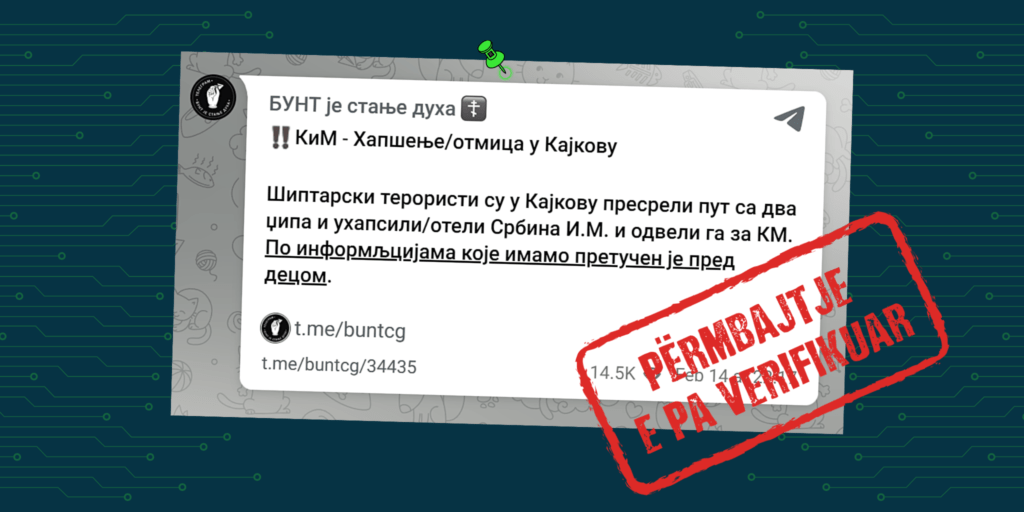

A social media account on "Telegram" with content in the Serbian language, today (February 15) claimed that Kosovo Police in the village of Kajkovë, Leposavic, arrested a person of Serbian nationality, whom, according to this account, they beat in the presence of children.
After research conducted by hibrid.info, it has been proven that the claim made by this account is untrue.
In the 24-hour report issued by the Kosovo Police (KP), regarding this case, it is stated that the aforementioned person was arrested and later released in a regular procedure, after he had disobeyed the orders of police officers and had hit an official Police vehicle with his vehicle.
Link to the post published on Telegram by the account “БУНТ је стънде духа” (Albanian: rebellion is a state of mind):

The post of the account “BUNT je stanje duha”, translated into Albanian:
Albanian terrorists in Kajkovë blocked their way with two jeeps and arrested/kidnapped the Serb, IM, and took him to North Mitrovica. According to the information we have, he was beaten in front of his children.
Hibrid.info has found the Kosovo Police announcement in the 24-hour report regarding this case. (see photo below)

As of the publication of this article, the post from the Telegram account has managed to accumulate over 14 thousand views. (see photo below)

Hibrid.info has previously handled notifications made by the Serbian-language Telegram account. (see here, here, here, here, here and here)
Analyze:
From the fact-checking and their analysis, it results that the claim made by “BUNT is a state of mind” is unfounded.
The facts that this Telegram channel claims to present to describe the claim made do not hold true.
In the 24-hour report of the Kosovo Police, it is explained that the person was arrested after he disobeyed the orders of police officers and hit an official KP vehicle with his vehicle.
Based on its work methodology, hibrid.info qualifies this claim as "misinformation".
Reasoning:
The "Unverified" rating is given to those informative contents that do not provide sufficient information to confirm the claims made in the report, and which could not be verified due to certain circumstances (speed, lack of sources) during the publication of the content.