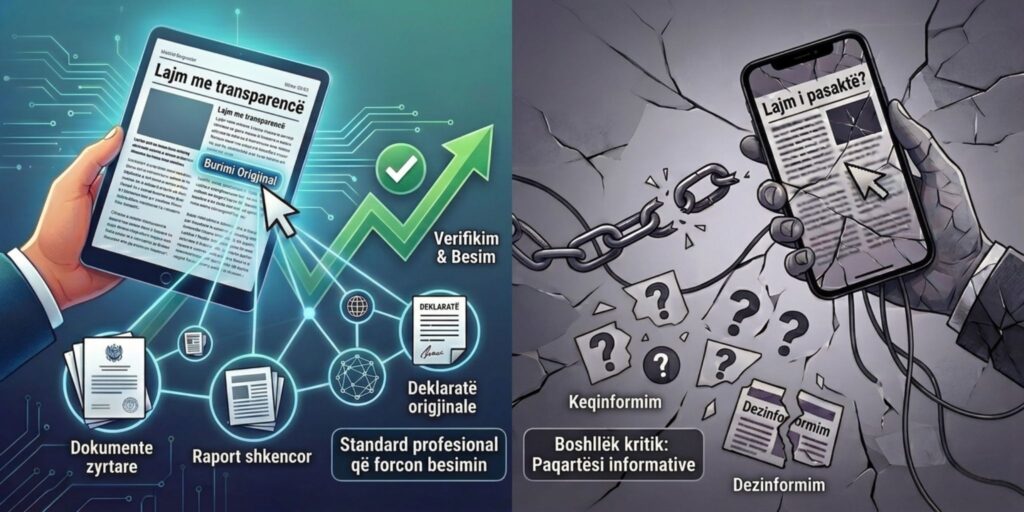

The hyperlink is one of the fundamental elements of digital journalism, functioning as a bridge between the information presented and its original source. In a media ecosystem overloaded with content and information, the hyperlink becomes a key mechanism for transparency and verifiability. It allows the reader to move from a passive position, where information is taken for granted, to an active verifying role, by clicking directly on sources such as reports, official documents or original statements.
From a theoretical perspective, the hyperlink is closely related to the concept of "radical transparency"in digital journalism, which means that the public should have access not only to the journalistic conclusion, but also to the process and sources on which that conclusion is built. As emphasized in the guidelines for digital journalism, the practices of direct linking to sources increase reliability and reduce the possibility of misinterpretationIn this sense, hyperlinking is not just a technical tool, but a professional standard that helps build trust between the media and the audience.
As Jonathan Stray argues in the analysis Why link out? Four journalistic purposes of the noble hyperlink, hyperlinks in online journalism serve four main functions: they help tell complex stories in a non-linear way, keep audiences informed through content curation, act as a "collaborative currency" between media actors, and increase transparency by enabling readers to directly verify sources.
The lack of hyperlinks in journalistic texts creates a critical gap in the information chain. When a claim is not accompanied by the relevant source, the reader has no way of verifying its authenticity, context or accuracy. This situation corresponds to what in communication literature is called “opacity information” (informational ambiguity), which increases the likelihood of misinformation and manipulation. For example, reports on disinformation from organizations such as First Draft have shown that content without clear references is more likely to be shared as truth, even when it is unverified or taken out of context.
In practice, the lack of hyperlinks makes it easy to chain-reproduce inaccurate information. An unsourced article can be cited by another medium, which is then cited by a third, creating an illusion of credibility through repetition. This phenomenon is also known as “information laundering", where unreliable information gains legitimacy through circulation. Without a link to the original source, it becomes almost impossible to identify the first point of deviation or manipulation.
Furthermore, in the context of social media, the lack of hyperlinking amplifies the problem. Most users consume only headlines or short excerpts, and if these do not contain a clear reference, the information is spread without any verification filter. Organizations like Reuters Institute have emphasized that source transparency is one of the main factors influencing the perception of news credibility in the digital age.
In conclusion, hyperlinking should be seen as an essential component of journalistic quality. It strengthens the integrity of information by making it verifiable, traceable and open to public scrutiny. On the other hand, its absence is not simply a formal deficiency, but a structural weakness that creates fertile ground for misinformation, manipulation and loss of trust in the media. At a time when the fight against disinformation has become a global priority, the use of hyperlinks is not an option – it is a professional necessity.