
Tuesday (April 28) was the deadline to elect the country's President. Kosovo's Assembly failed to elect him, which, according to the Constitution, led to its dissolution and sending the country to new elections. These elections come 77 days after the constitution of the Assembly, on February 11, when the government was also voted in by the parliamentary majority of the Vetëvendosje Movement (LVV) (see here).
This legislature emerged from the December 28 elections, in which LVV won the majority of votes with 51.11% (see here). After the dissolution of parliament, Article 30 of the Law on Government stipulates that the country is governed by a government in resignation (see here).
Meanwhile, Article 31 of this law limits its decision-making, allowing it only to necessary and planned activities, while prohibiting the approval of draft laws, constitutional amendments, strategies, as well as initiating or proposing appointments to public positions. Exceptionally, the government may propose the budget and, in emergency cases, deviate from these restrictions when necessary.
In this context, the question arises as to what were the decisions made by the government led by Albin Kurti during these 77 days in power?
The first five decisions promised by LVV
LVV had presented the program with which it competed in the elections of December 28. Although the mandate of the government and the Assembly resulting from these elections was interrupted due to the failure to elect a President within the constitutional deadlines, this program also included the first five decisions, which were expected to be implemented at the beginning of the new mandate (see here).
The decisions made were
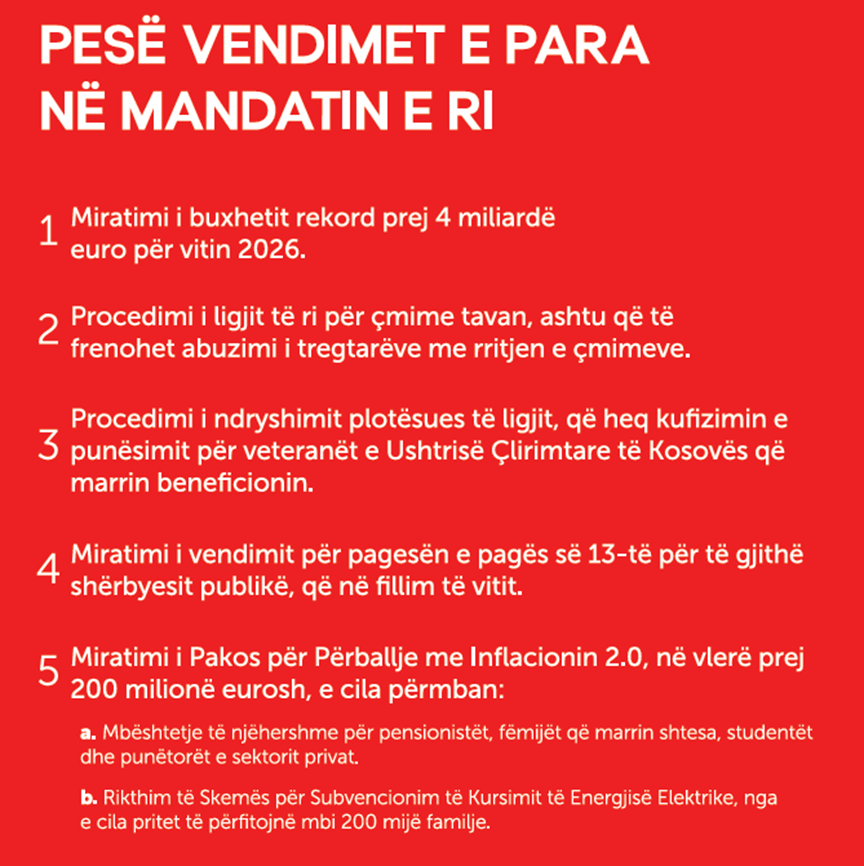
- Approval of a record budget of 4 billion euros for 2026.
- Proceduralization of the new law on ceiling prices, so as to curb the abuse of traders by increasing prices.
- Proceeding with the supplementary amendment to the law, which removes the employment restriction for Kosovo Liberation Army veterans who receive the benefit.
- Approval of the decision for the payment of the 13th salary for all public servants, since the beginning of the year.
- Approval of the Inflation Response Package 2.0, worth 200 million euros, which contains:
- One-time support for pensioners, children receiving benefits, students and private sector workers.
- Restoration of the Electricity Saving Subsidy Scheme, which is expected to benefit over 200 thousand families.
Realization of promises
The first decision in the new mandate was the approval of the budget of four billion euros for 2026. On February 16, five days after the constitution of the Assembly and the formation of the government, the draft law on the Kosovo budget for 2026 was approved in the first reading (see here). While four days later, in the second reading, the budget bill passed with 62 votes in favor, 36 against and no abstentions (see here).
The second decision The promised progress was the new Law on Price Caps. The Kosovo government passed the draft law on price caps on April 3. This was the second attempt to enforce this law, after the Constitutional Court had struck it down during the previous four-year mandate (see here).
This draft law was approved in first reading by the Assembly of Kosovo on April 10, and was finally approved on April 23 (see here).
Another promised initiative was the processing of supplementary amendments to the law, which aim to remove the employment restriction for veterans of the Kosovo Liberation Army (KLA) who receive benefits.
After researching through the Google search engine, no results were found confirming the launch of this initiative by this legislature or this government (see here).
The amendment and supplementation of three laws during 2026 on State-Funded Pension Schemes, KLA War Veterans and the Status and Rights of Martyrs, Invalids, Veterans, KLA Members, Civilian Victims and Their Families was announced through a status on his Facebook account by Andin Hoti, Minister of Labor, Family and Values of the Liberation War (see here).
Even a separate Google search for each of these laws did not yield results that would confirm that this promise has been fulfilled. (see here, here and here).
Decision on the 13th salary by the Government of Kosovo was taken on October 13, 2025. The decision was included in the approved budget for 2026 (see here). This decision was then implemented on March 30 of this year, when the Government of Kosovo approved the payment of the 13th salary for public sector workers (see here).
Final decision Promised by LVV among the first five decisions in the governing mandate was the approval of the Inflation Response Package 2.0, worth 200 million euros, which provided one-time support for pensioners, children receiving allowances, students and private sector workers, as well as the return of the Electricity Saving Subsidy Scheme, from which over 200 thousand families were expected to benefit.
In a speech to the Kosovo Assembly on April 3, Prime Minister Albin Kurti declared that the government is preparing an inflation package worth 200 million euros to cope with rising prices (see here).
On April 25, the Vetëvendosje Movement proposed in the Kosovo Assembly a deviation from the procedural deadline for reviewing the 2026 Budget Law. The proposal of this political entity did not receive support from 2/3 of the deputies present, for this reason the initiative as such failed (see here).
In a reaction to this failure, Hekuran Murati, the Minister of Finance, stated that the budget review was necessary to enable the implementation of the Inflation Response Package 2.0, worth 200 million euros (see here). This shows that this promised decision was not finalized.
In conclusion
Overall, the analysis shows that of the first five decisions promised by the LVV, three have been implemented or have been concretized in practice (the 2026 budget, the law on price ceilings and the 13th salary), while two others have not been implemented or have failed to be finalized (the changes for veterans and the Inflation Package 2.0).
This shows that a significant portion of the promises have been implemented at the decision-making level, but not all have moved to the full implementation phase within the analyzed period.