
Wrote: Etrit Rexhepi
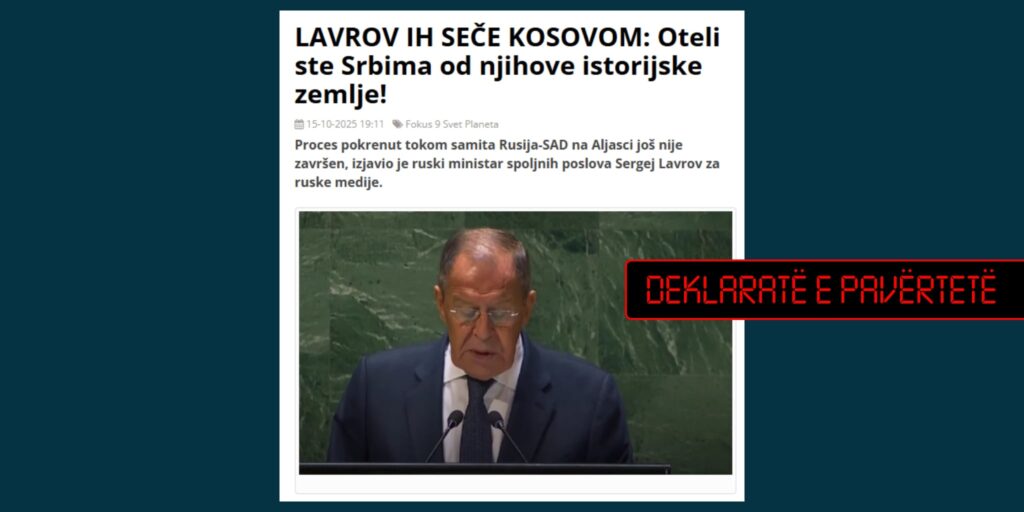
An article has been published with the title "LAVROV ON KOSOVO: You took away the Serbs' historic land!""
it CONTENT was published on Wednesday (October 15) in the Serbian-language media outlet "pravda.rs".
Hibrid.info has addressed the claim of a coup, which according to Sergey Lavrov, the Russian Minister of Foreign Affairs, came after the recognition of Kosovo's independence, which, according to him, seriously violated all the provisions of UN Security Council Resolution 1244.
This claim turns out to be incorrect because Kosovo's independence does not contain any element that fits the definition of a coup d'état.

Analyze:
"You know, they wanted to take Kosovo away from the Serbs. And they essentially did this by carrying out a coup d'état in 2008, because the unilateral recognition of Kosovo's independence grossly violated all the provisions of UN Security Council Resolution 1244, which defined the parameters of Serbian statehood, including Kosovo. They recognized Kosovo and, by this action, carried out a coup d'état - they took away from the Serbs their historical lands, associated with the birth of the Orthodox religion of the entire Serbian people, and much more," the Russian minister recalled.
This is Lavrov's statement presented in the text published on "pravda.rs".
To evaluate this claim, hibrid.info has researched the common characteristics that define a coup.
According to the Encyclopedia Britannica, which is a verified source for encyclopedic and historical information, “A coup d'état is the sudden and violent overthrow of an existing government by a small group. "The main condition for a coup d'état is control of all or part of the armed forces, police, and other military elements." (see here).
Similarly, according to Merriam-Webster, an Encyclopedia Britannica company, coup d'état is ""a sudden and decisive use of force in politics; especially: the violent overthrow or change of an existing government by a small group" (see here).
While according to an article with comparative studies, "A coup d'état is an illegal and overt attempt by the military or elites within the state apparatus to overthrow the existing leadership. (see here)
From these definitions, several key characteristics can be deduced that distinguish a coup d'état from other forms of political change: it is usually undertaken by a relatively small group of political or military elites, uses force or the threat of force, occurs outside constitutional and legal procedures, aims to overthrow existing leaders or replace the government, and utilizes internal state structures, such as the military or police, to achieve the goal.
As for the declaration of Kosovo's independence, no definition has been found that could link it to any coup d'état.
Resolution 1244, adopted in 1999 by the UN Security Council, does not define Kosovo as part of the “Serbian statehood”, but temporarily recognizes the formal sovereignty of the FRY (Serbia and Montenegro at the time), in the meantime, establishes an international UN administration in Kosovo (UNMIK) and a NATO peacekeeping force (KFOR) and provides for a political process for determining the final status of Kosovo, which implies that its status was not permanent (see here).
On 17 February 2008, the Kosovo Assembly declared Kosovo an independent state. The declaration of independence was contested by Serbia. However, in 2010, the International Court of Justice (ICJ) ruled that Kosovo's declaration of independence did not violate international law, because it “did not violate any general rule of international law, nor Resolution 1244, nor the UNMIK interim constitutional framework” (see here).
Sergey Lavrov's statement was made on October 15, 2025, during a press conference in Russia, following the summit held in Alaska between Russian President Vladimir Putin and American President Donald Trump.
In that context, Lavrov was commenting on the results of that summit, speaking about "the root causes of conflicts, comparing the case of Kosovo with the situations in Ukraine (2014) and in the territories occupied by Russia."
So, the statement was made as part of a Russian political narrative that aims to legitimize Russia's interventions in Ukraine and present the West as responsible for the "division of historical territories", using Kosovo as a comparative example to justify the Kremlin's policies (see here, here and here).
Conclusion:
Russian top diplomat Sergey Lavrov claimed that the recognition of Kosovo's independence in 2008 constituted a "coup d'état" because, according to him, it violated UN Security Council Resolution 1244 and took away "historical land" from the Serbs.
The recognition of Kosovo’s independence declared in 2008 cannot be considered a “coup d’état,” as it does not meet any of the characteristics that define such an act. It was not carried out by a small group of political or military elites, did not involve the use of force or the overthrow of the existing government, and did not occur within the structures of the Serbian state.
Rather, independence was declared after an international process overseen by the UN and the international community. Resolution 1244 does not define Kosovo as a permanent part of Serbian statehood, but rather provides for a political process to determine its final status.
Likewise, the decision of the International Court of Justice in 2010 confirmed that Kosovo's declaration of independence did not violate international law, neither Resolution 1244 nor the constitutional framework of UNMIK.
Therefore, based on the working methodology for checking and evaluating statements, Minister Lavrov's claim is assessed as a "false statement".
Reasoning:
Hibrid.info, in addition to checking and analyzing media articles, also checks and evaluates statements by senior political and institutional officials, as well as those figures who have public influence.
The evaluation of these figures, according to the hibrid.info methodology, is done in the categories of truthfulness, sustainability, and content of promises.
In the category of truthfulness, those statements that contain statements related to objective facts, the accuracy of which can be determined through objective verification, are evaluated. Statements treated in this category receive the rating – false statement, half-truth, or even true statement. national as well as those figures who have public influence.