

Russian media outlets in Serbian have published a statement by the spokesperson for the Russian Foreign Ministry, Maria Zakharova, regarding the armed attack on a concert hall near Moscow on March 22, 2024.
Despite the fact that the militant group, the Islamic State (ISIS), claimed responsibility for this attack, Zakharova blamed Ukraine for links to this group, adding that this country is even surpassing Kosovo in terms of terrorism.
The mention of Kosovo in relation to terrorism is not substantiated by Zakharova.
Link to Zakharova's statement published in Russian media in Serbian:
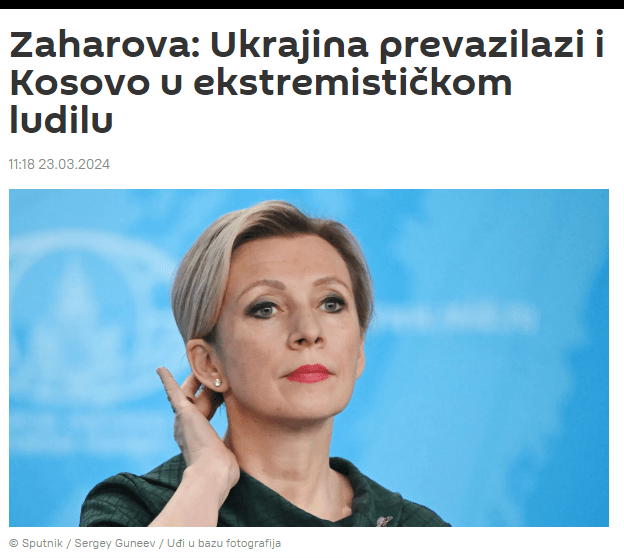
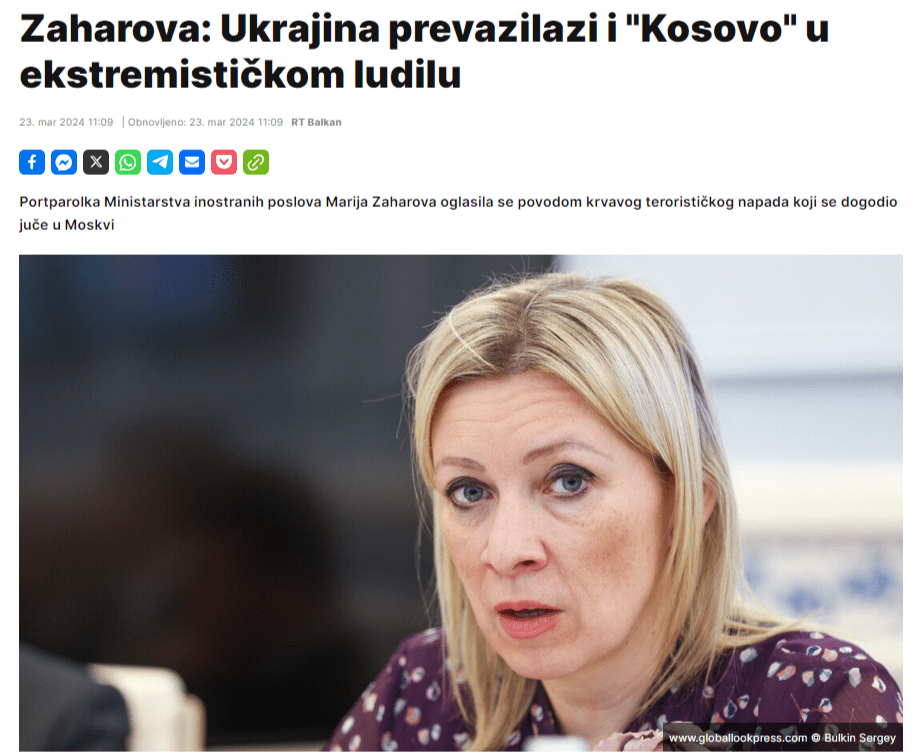
https://lat.rt.rs/rusija/82064-zaharova-napad-ukrajina-kosovo/
Parts of Zakharova's statement translated into Albanian:
"Now we know in which country these bloodthirsty bastards planned to hide from persecution - in Ukraine. The same country that, in the hands of liberal Western regimes, has become a center of the spread of terrorism in Europe for ten years, surpassing even the so-called Kosovo in extremist madness," Zakharova said.
Foreign Ministry spokeswoman Maria Zakharova, commenting on claims that the terrorists who participated in the Moscow attack were arrested not far from the Ukrainian border, said that Ukraine has surpassed even the so-called Kosovo in terms of terrorism.
As for Ukraine's involvement in the attack near Moscow, this was denied by Ukrainian state officials, stating that Ukraine "has never used terrorist methods." (here)
The disinformation connection between developments in Ukraine and Kosovo by Russia is one of the disinformation narratives used after the Russian aggression in Ukraine. Often, both Russian officials and media close to the government there have referred and continue to refer to Kosovo to create parallels with the aggression in Ukraine. (See the full article on Russian disinformation narratives related to Kosovo, here)
Recently, Zakharova also tried to link the attack, described as terrorist, at the concert hall near Moscow to Ukraine, also mentioning Kosovo as a hotbed of extreme religious terrorism. Zakharova fails to substantiate this.
Such a narrative about the involvement of religious extremist groups in Kosovo, as well as the description of Kosovo as one of the hotbeds of this, has also been made by Serbian-language media, which have not been substantiated but have remained as a disinformation narrative. (here, here, here, here)
Furthermore, the Republic of Kosovo has published the state strategy for preventing and combating terrorism 2023-2028, which highlights the fact that:
“The Republic of Kosovo will continue to be an active part of the global fight against terrorism and its financing, through close cooperation and coordination with partners and international mechanisms that address this area. In responding to all forms of terrorism, the Republic of Kosovo and its institutions are guided by the United Nations Global Counter-Terrorism Strategy, which is a roadmap for every effort to counter these phenomena. State authorities are also implementing the Agreement with the European Commission on the implementation of the Joint Action Plan against Terrorism for the Western Balkans, the validity and continuation of which has been extended to October 2020.” (here)
In addition, Kosovo has international cooperation, including with the US, to combat terrorism, and is a member of the Global Coalition against the militant group, ISIS.here)
Analyze:
The mention of Kosovo in connection with terrorism by the spokeswoman, Zakharova, after the attack on a concert hall near Moscow, is unfounded.
Kosovo has a state strategy for preventing and combating terrorism and is part of international organizations against the militant group, the Islamic State (ISIS).
Based on its work methodology, hibrid.info considers this claim to be a "conspiracy theory".
Assessment/definition:
"Conspiracy theories" are considered to be informational content that contains a false or unverifiable description of a phenomenon, event or person, presenting it as part or the result of a secret plan ("conspiracy"). The characteristic of these contents is that they present a series of claims, presented as facts, between which cause-effect relationships are established, without providing any reliable evidence.