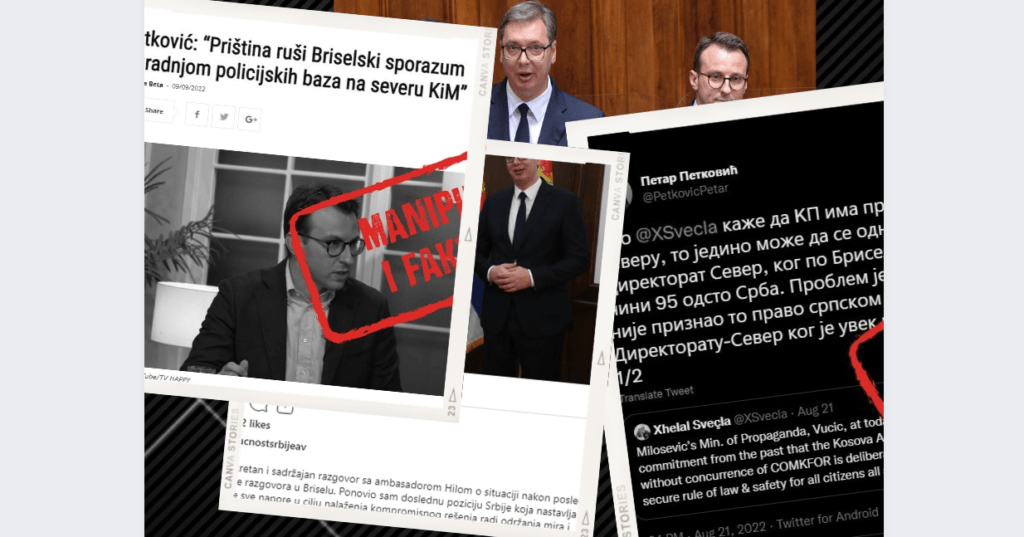

The article with misinformation from the Kurir.rs medium was corrected after being handled by hibrid.info (see the corrected article). here)
Senior Serbian political leaders from official Belgrade continue to use in their frequent discourse almost every development that occurs in northern Kosovo, a region dominated by residents of the Serbian community.
Hibrid.info has treated some of these recent statements through the prism of narrative analysis. This form of analysis was done with the understanding that the statements of these Serbian political representatives seem to be coordinated and very similar, made time and again by some of them, which makes it clear that this is a political narrative.
Political narrative is a term used in the humanities and political sciences to describe the way in which storytelling can shape facts and influence the understanding of an objective or subjective reality (see here description of this theory). The message of a political narrative can be communicated through texts, images, metaphors, and other means. Narratives also help convey a message by creating compelling information.
In several previous analyses, hibrid.info has addressed the latest narratives from the government in Serbia and broadcast by some media outlets in this country, which are considered close to the government.
The narratives analyzed earlier aimed to “push forward” unfounded claims about “implementation of the recent agreement on border crossing between Kosovo and Serbia with ID cards", for "Albanians preparing for attack on Serbs in Kosovo","Prime Minister Kurti's calls for war" or "expulsion of Serbs from Kosovo".
The latest narrative: Pristina has no right to send police to the north without KFOR's permission
Senior political representatives in Serbia have, in several of their statements, called the operation of Kosovo Police units in the north illegal and a violation of the Brussels Agreement.
Among the first was the President of Serbia, Aleksandar Vučić, who, in several public appearances at the end of last month, mentioned this claim.
"Stressing the tensions that exist in Kosovo and Kosovo, President Vučić said that it is important for Pristina to adhere to the agreement that Kosovo special forces can move to the north only with the consent of NATO and the mayors of the four municipalities where Serbs live.", Vučić said (see here).
In addition to him, the same claim, with similar wording, was made by the head of the Office for Kosovo in the Government of Serbia, Petar Petkovic. Through a statement from the institution he heads, he claimed that, based on a Brussels Agreement, the Kosovo Police cannot operate in northern Kosovo without the consent of NATO and the mayors of the four municipalities where Serbs live (see here)
Repetition of this narrative
The same narrative was used on several occasions by these two Serbian politicians. Recently, it has also started to be used again, but now mainly brought back only by Petkovic.
Kosovo's Minister of Internal Affairs, Xhelal Sveçla, in an interview for the show "DPT te Fidan Jupolli" on "t7" television made at midnight on Thursday (September 8), said that they have built several police bases in the northern part of Kosovo, including the border area.
https://www.facebook.com/t7videos/videos/575814254286038/
Immediately after this statement, Petkovic repeated this false claim that official Pristina is violating the Brussels agreement by building police bases in the north and is illegally taking over KFOR's responsibilities (see here treatment from hibrid.info)
The dissemination of this narrative also by media close to the government
This claim made by Petkovic has been published unconfirmed by some of the media outlets known to be close to the government in Serbia (see here).
These media outlets have published this claim by Petkovic with tendentious headlines and unverified content (see publications in these media outlets). here, here and here)
Why is this narrative not true?
The insistence of these senior Serbian representatives that the Kosovo Police has no legal right to operate in northern Kosovo turns out to be untrue.
In their statements, they refer to the Brussels Agreement, which is the one for the Normalization of Relations between Kosovo and Serbia, reached on April 19, 2013 between the two then prime ministers of Kosovo and Serbia, respectively, Hashim Thaçi and Ivica Dacic, (here) which provides in more detail the functioning of the Kosovo Police in the north of the country.
In this agreement, which was ratified by the Assembly of Kosovo on June 27, 2013 (here), the functioning of the Kosovo Police is envisaged:
"There will be a police force in Kosovo, called the Kosovo Police. All police in northern Kosovo will be integrated into the Kosovo Police framework. Salaries will be paid only by the KP. 8. Members of other Serbian security structures will be offered positions in equivalent Kosovo structures". (see point 7 of the document of this ratified agreement here)
So, according to this agreement signed by the Prime Minister of Serbia himself, of which the current President Vučić was also a part as First Deputy Prime Minister (here), it is envisaged that the Police in northern Kosovo will be integrated within the framework of the Kosovo Police. However, this document does not contain details about its functioning in the north.
Hibrid.info also reviewed the Law on the Kosovo Police to verify whether the statement of these two Serbian officials is true, since the operation of this security institution in Kosovo is regulated only according to this relevant law. According to Article 4, point 3 of the Law on the Police, it is stated that “The Police operates through a unified chain of command throughout the territory of the Republic of Kosovo” (see the law here), without making any regional distinction.
Even the claim that KFOR is solely responsible for security in the north is unfounded. The agreement of April 19, 2013 between former NATO Secretary General Anders Fogh Rasmussen and former Kosovo Prime Minister Hashim Thaçi, both in office at the time, is only about limiting the operation of the KSF in northern Kosovo, without the permission of KFOR, and not the Kosovo Police (here).