
Wrote: Fatbardh Dema
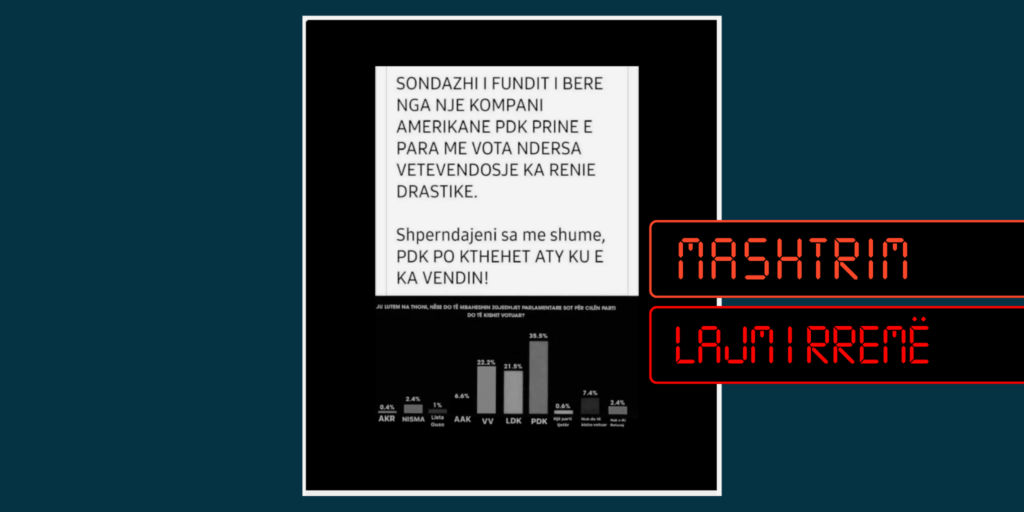
A post made on TikTok claims that a new poll has been published regarding the parliamentary elections in Kosovo.
The publication was made by the account named "mentoralbodollar".
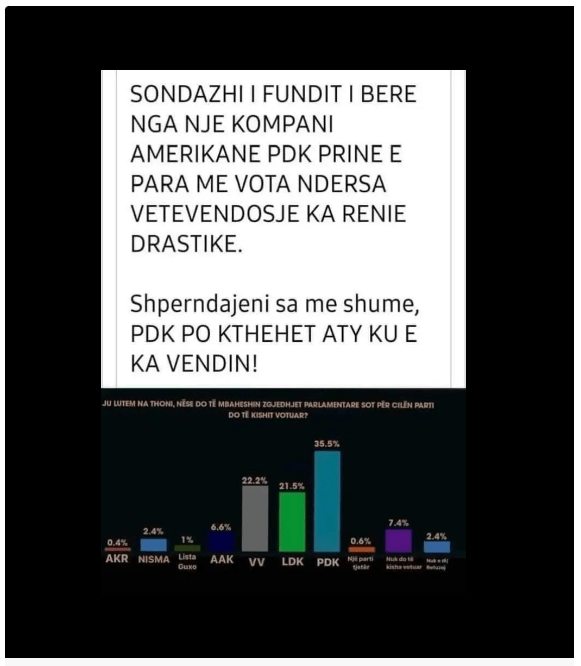
The caption of this publication states that this survey was conducted by an American company and that the Democratic Party of Kosovo (PDK) leads with 35.5%.
What's wrong with this claim?
After verification, hibrid.info has found that this publication uses data from an old survey and that in the post made today by the "mentoralbodollar" account, the names of the political parties leading in the survey have been changed.
Link to the post published on TikTok by the account "mentoralbodollar":
https://www.tiktok.com/@mentoralbodollar/photo/7408047582166945056
What is the manipulation with this survey?
After verification, hibrid.info found that the publication used data from a research published in December 2022, by the "PIPOS" Institute on the "Rubikon" show on KlanKosova (see here).
In the results published at the time by "PIPOS", the Vetëvendosje Movement (VV) was in the lead with 35.5%. The Democratic League of Kosovo (LDK) was second with 22.2% and the Democratic Party of Kosovo (PDK) was third with 21.5%.
So, in the TikTok post by the account "mentoralbdollar", the order of the parties on the list has been changed. PDK is in first place with 35.5%, VV in second (22.2%) and LDK in third (21.5%).
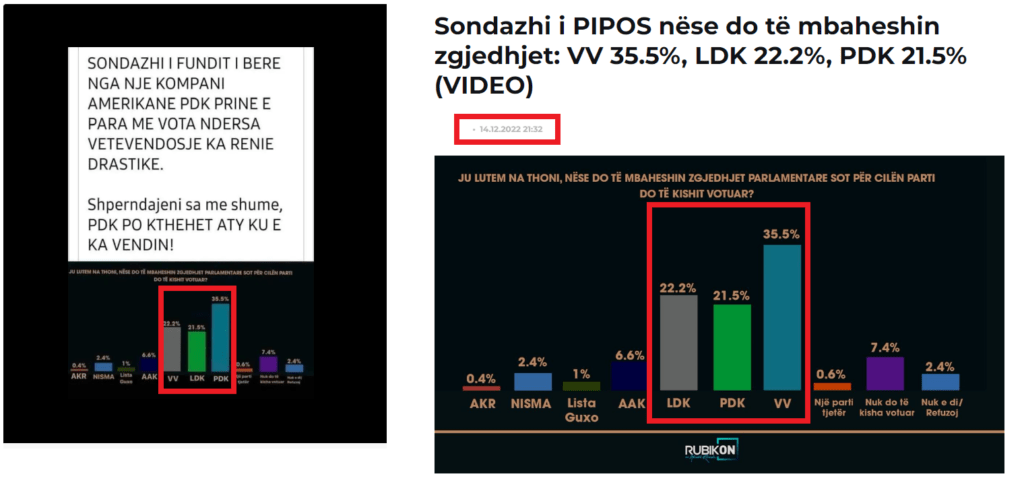
This manipulated poll was also published on February 22 of this year by another TikTok account, which was also verified by hibrid.info (see here)
Analyze:
The account named "mentoralbdollar" on TikTok has claimed to have published a new survey regarding the parliamentary elections in Kosovo, adding that it was conducted by an "American company."
After verification, hibrid.info has found that this is not a new survey. This publication uses data from an old survey, conducted by the "PIPOS" Institute in Kosovo, which was manipulated by changing the order of the parties on the list.
Based on its work methodology, hibrid.info assesses the content as "Fraud" and "Fake News".
Reasoning:
The “Deception” rating is given to informational content that is manipulated in terms of visual (deepfake, cheapfake), audio, or textual content to deceive the audience. This form of deception is usually used to produce false and manipulated content.
The “Fake News” rating is given to informational content that is entirely fabricated or that contains factually incorrect claims or information. Content that is rated as fake news can be defined as having been created and distributed with the intent to misinform the public, i.e., to present a claim that is completely false as fact.