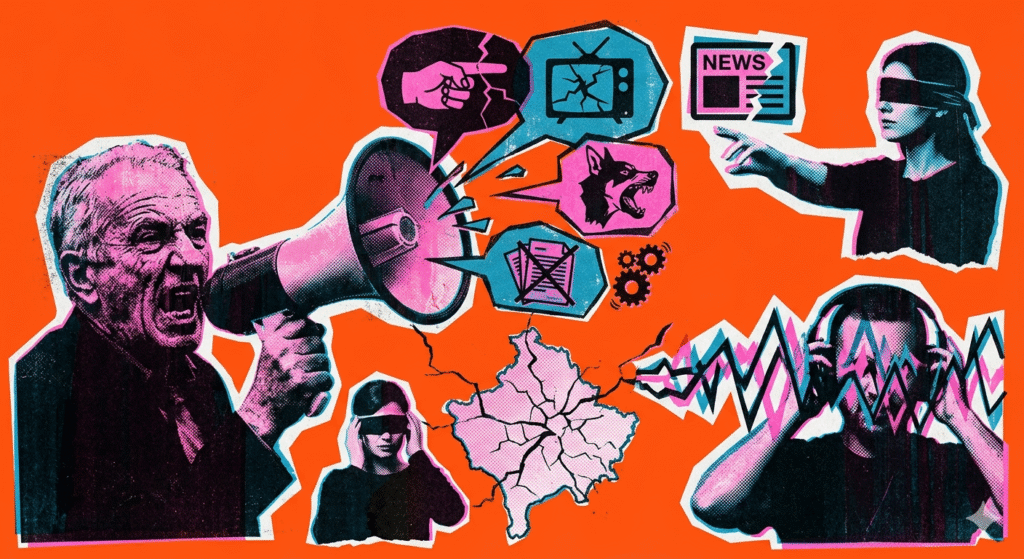

This text presents possible misinformation narratives that may appear in the period following the end of the elections, in this case the parliamentary elections held on June 7, based on the treatment of misinformation content in the last two political processes in Kosovo.
Through the analysis of past cases, readers are warned about the main sources and narratives that are expected to be used to spread misinformation.
Political situation that can encourage misinformation
The period after the end of the voting process, when the official results have not yet been certified, creates an information vacuum. This period of waiting for postal votes, conditional votes and votes for people with special needs, and talks about coalitions, is often exploited by untrustworthy sites to spread misinformation.
Monitoring of past elections in Kosovo shows that post-election fraud usually follows certain recurring scenarios.
Expected scenarios:
Misinformation addressed after the February 9 and December 28 elections
To predict what kind of misinformation may be published in the coming days, hibrid.info has analyzed the content that was discussed in two two-week periods after the elections, namely after February 9 and after December 28 of last year.
During these periods, hibrid.info has dealt with various content, including such things as fabricated vote figures, clickbait headlines about resignations or coalition agreements, recycling of old images and videos to present secret coalitions, fake quotes from local and international officials, as well as alarmist narratives about the alienation of political will.
For example, following the February 9 elections, content was addressed claiming that the Democratic Party of Kosovo (PDK) had secured 93.82% of the postal votes (see here). Also, premature and fabricated claims were spread that supposedly “the results of the diaspora votes were already known in advance” (see here) or that certain candidates had suffered a debacle, as in the case of the false claim that Ragip Xhaka had received only 34 votes in those elections (see here).
In the area of political negotiations and partnerships, content with titles that did not clarify the full context was identified, such as the case when it was reported about the resignation of a senior PDK official, who in fact belonged only to a branch of this entity in Germany (see here), or when a journalist's assumption in a television studio was featured in the headlines as a confirmed deal for the presidential candidate (see here) and the case of a Facebook post that did not clarify that the content was about a local coalition in Podujevo (see here),
Also, an incorrect claim was published about the legal restrictions on politicians, such as the case when it was claimed that Fatmir Limaj cannot take government positions if he enters the government with Kurti (see here).
Much of this manipulative content also featured narratives of secret meetings and coalitions. In some cases, old visual materials were used to depict actual meetings of leaders, such as old photographs claiming that Ali Ahmeti met in Pristina with opposition party leaders after the elections (see here), or the use of an old video through which it was falsely claimed that Kurti had visited the offices of the Serbian List to coordinate on the formation of the government (see here). The connection with the Serbian List or its exponents was also claimed in several other treatments, where fabricated statements by Serbian President Aleksandar Vučić were distributed, that the government in Kosovo would be formed by the Serbian List with the parties that were in the opposition (see here) or that he too had sought such a coalition (see here).
At the same time, manipulated statements and positions of state leaders and international partners were also published to change the perception of political support. Hibrid.info verified false quotes claiming that Vjosa Osmani, then in her capacity as president, had declared that the victory of the Vetevendosje Movement (LVV) was in the best interest of Kosovo (see here), that the opinion leader Baton Haxhiu had said that LVV could not form the government (see here), or that Faton Peci had warned a new parliamentary group if LVV did not support Osmani for president (see here).
Meanwhile, on the international level, a false claim was addressed that the Turkish foreign minister had congratulated Kurti on his victory (see here) and an old assessment of the US Embassy on the situation in the north of the country was republished, presenting it as current (see here).
There was also no shortage of alarmist narratives and disinformation, mainly in Serbian by officials such as Petar Petković, in which it was claimed without any evidence that attempts were being made to alienate the will of Serbian citizens or that there had been theft of the votes of these same citizens (see here and here).
Anticipating potential misinformation sources and narratives
Based on the cases handled by hibrid.info after the February 9 and December 28 elections, potential sources of misinformation in the coming days may include unreliable websites, various accounts on social media platforms (such as TikTok and Facebook), and in some cases even the media itself.
From these sources, narratives such as the spread of false results for certain political entities or candidates, especially from diaspora votes, are expected to be published and dominate, before they are officially made public by the Central Election Commission (CEC).
Allegations of reaching secret governing coalitions and false connections of Albanian parties with the Serbian List and Serbian President Vučić;
Allegations without concrete evidence of manipulation and theft of the will of citizens;
As well as attributing statements that political leaders never said.
conclusion
To avoid the impact of misinformation and to have an accurate picture of post-election political developments, it is essential to: not trust figures or percentages that are not published by the Central Election Commission (in public statements, on the official website, on official pages on social networks); to verify statements by leaders or other institutions, directly on their verified profiles or through highly credible media; to critically analyze every short video on social networks, checking the original date of the event before taking it for granted; to understand the context of short videos distributed on social networks, as in many cases videos of public statements by political officials are intentionally shortened, edited and manipulated to present their positions on certain issues with statements that are not related to those alleged issues.